Knowledge Test Class A
This license is required for driving any legal combination of vehicles, with a gross combination weight rating of 26,001 pounds or more, provided the GVWR of a trailer exceeds 10,000 pounds To receive this license, applicants must pass a 50-question test. To pass, applicants must answer 40 questions correctly. Each question has four possible answer choices. Test questions come from the Kansas Commercial Driver License Manual. Questions come from chapters covering: Introduction, Driving Safely, Transporting Cargo Safely, Air Brakes (if applicable), Combination, Doubles and Hazardous Materials. Endorsements that may be used with a Class A CDL are: Hazardous materials, Tank, Passenger, HazMat and Tank, Air Brakes and School bus.
Number of Question
Passing Score
15. During an applied leakage test, the maximum leakage rate for a triple combination vehicle is:
Explanation
It is important to know the maximum air loss rate that is safe for your specific vehicle. A triple combination should have a leakage rate no higher than 6 psi in a minute during an applied leakage test.
16. An Anti-Lock Braking System (ABS) will:
Explanation
Anti-Lock Braking Systems (ABS) will help you to maintain control during hard braking. ABS will not necessarily shorten your stopping distance.
17. A vehicle stopped at a green light may indicate that the driver:
Explanation
It is important to observe other drivers' actions and identify clues that a person could be driving impaired. Drivers who have had too much to drink, are sleepy, are on drugs, or are ill can present hazards to other drivers. One sign that a driver may be impaired is that they stop in inappropriate places, such as at green traffic lights.
18. For safety purposes, when should you turn off a retarder?
Explanation
Retarders are mechanisms in some vehicles that help slow a vehicle and reduce the need for braking. However, using a retarder may cause wheels to skid when they have poor traction. Turn off retarders when traveling under wet, snowy, or icy conditions.
19. What is reaction distance?
Explanation
Reaction distance is the distance traveled between the moment you mentally recognize a hazard and when you physically hit the brakes.
20. Brakes may get out of adjustment:
Explanation
Brakes can get out of adjustment quickly, especially if they are used to the point of overheating. Brake adjustment should be checked frequently.
21. When driving:
Explanation
It is important to communicate your intentions to others on the road. Make sure to signal before turning or changing lanes, even if no other vehicles are nearby.

Frequently Asked Questions
A Class A CDL (Commercial Driver's License) license in Kansas allows a driver to operate a combination of vehicles with a weight of 26,001 pounds or more, provided that the weight of the vehicle being towed is more than 10,000 pounds. This type of license is required for drivers who operate tractor-trailers, tanker trucks, and other large commercial vehicles.
Here are the steps to obtain a Class A CDL license in Kansas:
1. Obtain a commercial learner's permit (CLP) by passing a written knowledge test and a vision test. You must be at least 18 years old to obtain a CLP.
2. Hold the CLP for at least 14 days before taking the skills test.
3. Pass a skills test in a Class A vehicle, which includes pre-trip inspection, basic vehicle control, and on-road driving tests.
4. Provide proof of citizenship or lawful presence in the United States.
5. Submit to a medical examination and provide a medical examiner's certificate.
6. Provide proof of your social security number.
7. Pay the required fees.
Once you have obtained your Class A CDL license, you must comply with all Kansas traffic laws and regulations related to commercial driving.
Here are the steps to obtain a Class A CDL license in Kansas:
1. Obtain a commercial learner's permit (CLP) by passing a written knowledge test and a vision test. You must be at least 18 years old to obtain a CLP.
2. Hold the CLP for at least 14 days before taking the skills test.
3. Pass a skills test in a Class A vehicle, which includes pre-trip inspection, basic vehicle control, and on-road driving tests.
4. Provide proof of citizenship or lawful presence in the United States.
5. Submit to a medical examination and provide a medical examiner's certificate.
6. Provide proof of your social security number.
7. Pay the required fees.
Once you have obtained your Class A CDL license, you must comply with all Kansas traffic laws and regulations related to commercial driving.
With a Class A CDL (Commercial Driver's License) license in Kansas, you can operate a combination of vehicles that have a total weight of 26,001 pounds or more, provided that the weight of the vehicle being towed is more than 10,000 pounds. This includes:
1. Tractor-trailers: A combination of a truck tractor (also known as a cab) and one or more trailers.
2. Tanker trucks: Vehicles designed to transport liquids or gases, such as gasoline, oil, or chemicals.
3. Livestock carriers: Vehicles designed to transport live animals, such as cows, pigs, or horses.
4. Flatbed trucks: Vehicles with an open flat platform for transporting large items such as machinery or building materials.
5. Refrigerated trucks: Vehicles with refrigeration units for transporting perishable goods such as food or pharmaceuticals.
6. Double and triple trailers: A combination of two or three trailers attached to a truck tractor.
It is important to note that you may need additional endorsements on your CDL license to operate certain types of vehicles, such as hazardous materials (HazMat) or passenger vehicles.
1. Tractor-trailers: A combination of a truck tractor (also known as a cab) and one or more trailers.
2. Tanker trucks: Vehicles designed to transport liquids or gases, such as gasoline, oil, or chemicals.
3. Livestock carriers: Vehicles designed to transport live animals, such as cows, pigs, or horses.
4. Flatbed trucks: Vehicles with an open flat platform for transporting large items such as machinery or building materials.
5. Refrigerated trucks: Vehicles with refrigeration units for transporting perishable goods such as food or pharmaceuticals.
6. Double and triple trailers: A combination of two or three trailers attached to a truck tractor.
It is important to note that you may need additional endorsements on your CDL license to operate certain types of vehicles, such as hazardous materials (HazMat) or passenger vehicles.
To obtain a Class A CDL (Commercial Driver's License) license in Kansas, you must meet the following requirements:
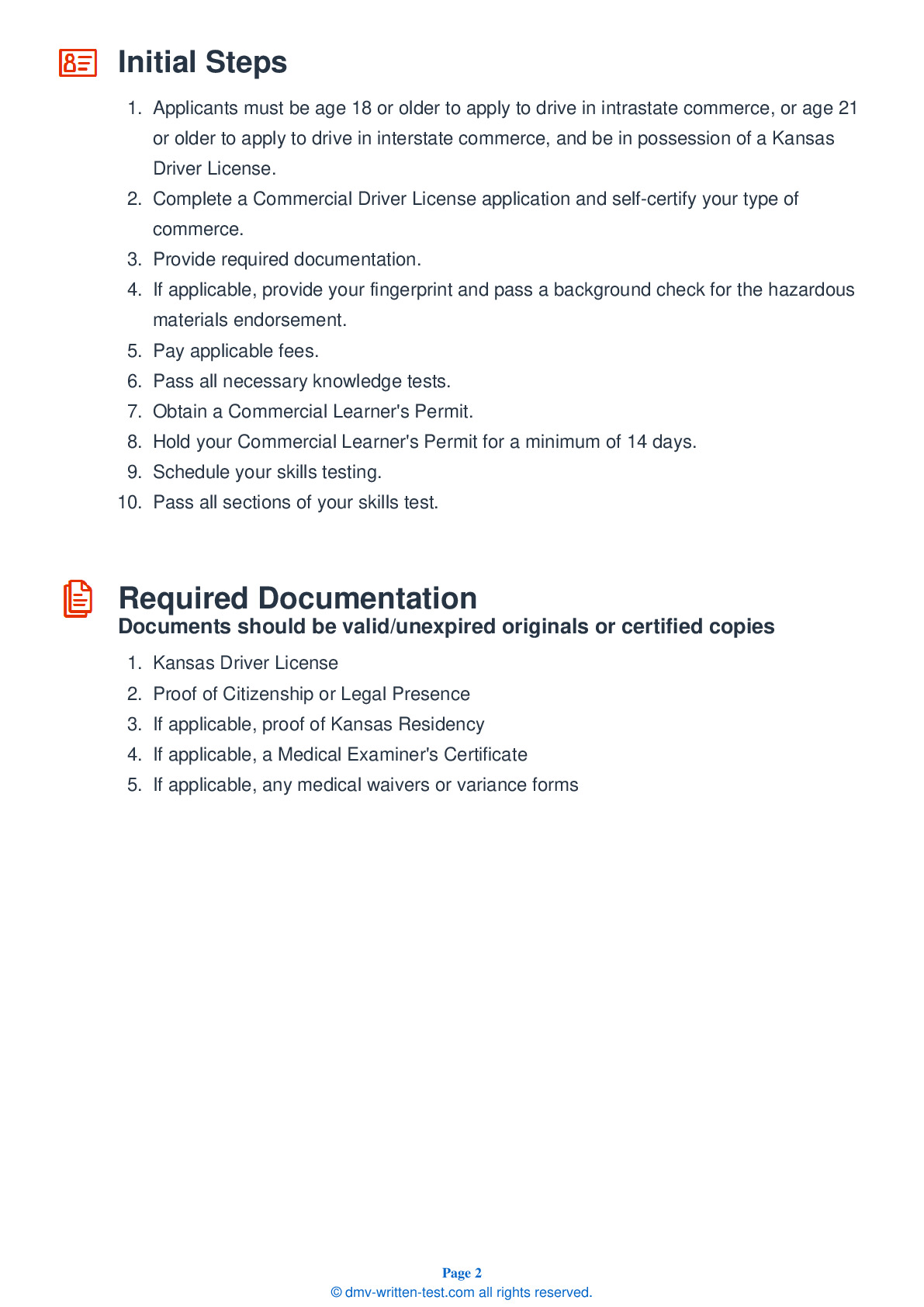
1. Be at least 18 years old to drive within Kansas and at least 21 years old to drive interstate.
2. Hold a valid driver's license.
3. Provide proof of citizenship or lawful presence in the United States.
4. Obtain a commercial learner's permit (CLP) by passing a written knowledge test and a vision test.
5. Hold the CLP for at least 14 days before taking the skills test.
6. Pass a skills test in a Class A vehicle, which includes pre-trip inspection, basic vehicle control, and on-road driving tests.
7. Provide proof of your social security number.
8. Submit to a medical examination and provide a medical examiner's certificate.
9. Pay the required fees.
It is important to note that you must also have a clean driving record and not have any disqualifying offenses such as DUI or leaving the scene of an accident. Additionally, you may need to obtain additional endorsements on your CDL license to operate certain types of vehicles or transport hazardous materials (HazMat).
1. Be at least 18 years old to drive within Kansas and at least 21 years old to drive interstate.
2. Hold a valid driver's license.
3. Provide proof of citizenship or lawful presence in the United States.
4. Obtain a commercial learner's permit (CLP) by passing a written knowledge test and a vision test.
5. Hold the CLP for at least 14 days before taking the skills test.
6. Pass a skills test in a Class A vehicle, which includes pre-trip inspection, basic vehicle control, and on-road driving tests.
7. Provide proof of your social security number.
8. Submit to a medical examination and provide a medical examiner's certificate.
9. Pay the required fees.
It is important to note that you must also have a clean driving record and not have any disqualifying offenses such as DUI or leaving the scene of an accident. Additionally, you may need to obtain additional endorsements on your CDL license to operate certain types of vehicles or transport hazardous materials (HazMat).
In Kansas, you must be at least 18 years old to obtain a Class A CDL (Commercial Driver's License). However, drivers who are 18 to 20 years old may only operate commercial vehicles within the state of Kansas and may not transport hazardous materials (HazMat) or operate double or triple trailers.
If you want to drive a commercial vehicle across state lines, you must be at least 21 years old. Additionally, some trucking companies may have their own age requirements that are higher than the minimum legal age. It is important to check with your employer or potential employer to determine any additional age requirements.
If you want to drive a commercial vehicle across state lines, you must be at least 21 years old. Additionally, some trucking companies may have their own age requirements that are higher than the minimum legal age. It is important to check with your employer or potential employer to determine any additional age requirements.
Yes, you may need to obtain additional endorsements on your Class A CDL (Commercial Driver's License) license in Kansas to operate certain types of vehicles or transport certain types of cargo. The following are the most common endorsements:
1. HazMat: This endorsement is required to transport hazardous materials. To obtain this endorsement, you must pass a background check and a written test.
2. Tanker: This endorsement is required to haul liquids or gases in bulk containers. To obtain this endorsement, you must pass a written test.
3. Doubles/Triples: This endorsement is required to pull double or triple trailers. To obtain this endorsement, you must pass a written test.
4. Passenger: This endorsement is required to drive vehicles designed to transport 16 or more passengers, including the driver. To obtain this endorsement, you must pass a written test and a skills test in a passenger vehicle.
It is important to note that some endorsements may have additional requirements, such as passing a skills test in addition to the written test. Additionally, there may be additional fees associated with obtaining endorsements.
1. HazMat: This endorsement is required to transport hazardous materials. To obtain this endorsement, you must pass a background check and a written test.
2. Tanker: This endorsement is required to haul liquids or gases in bulk containers. To obtain this endorsement, you must pass a written test.
3. Doubles/Triples: This endorsement is required to pull double or triple trailers. To obtain this endorsement, you must pass a written test.
4. Passenger: This endorsement is required to drive vehicles designed to transport 16 or more passengers, including the driver. To obtain this endorsement, you must pass a written test and a skills test in a passenger vehicle.
It is important to note that some endorsements may have additional requirements, such as passing a skills test in addition to the written test. Additionally, there may be additional fees associated with obtaining endorsements.
The Class A CDL (Commercial Driver's License) skills test in Kansas consists of three parts:
1. Pre-Trip Inspection: You will be asked to inspect your vehicle and identify any potential safety hazards. You will need to show the examiner that you know how to check basic components like brakes, tires, lights, and mirrors.
2. Basic Vehicle Control Skills: You will be asked to demonstrate your ability to control the vehicle in a variety of situations. This includes backing up, turning, and parking.
3. On-Road Driving: You will need to demonstrate your ability to safely operate the vehicle on public roads. This includes merging onto highways, changing lanes, and navigating intersections.
The skills test is conducted in a vehicle that is representative of the type of commercial vehicle you will be driving. You must pass all three parts of the skills test to obtain your Class A CDL. It is important to note that the skills test is rigorous and requires a lot of practice and preparation. It is recommended that you enroll in a reputable truck driving school or training program to ensure that you are adequately prepared for the skills test.
1. Pre-Trip Inspection: You will be asked to inspect your vehicle and identify any potential safety hazards. You will need to show the examiner that you know how to check basic components like brakes, tires, lights, and mirrors.
2. Basic Vehicle Control Skills: You will be asked to demonstrate your ability to control the vehicle in a variety of situations. This includes backing up, turning, and parking.
3. On-Road Driving: You will need to demonstrate your ability to safely operate the vehicle on public roads. This includes merging onto highways, changing lanes, and navigating intersections.
The skills test is conducted in a vehicle that is representative of the type of commercial vehicle you will be driving. You must pass all three parts of the skills test to obtain your Class A CDL. It is important to note that the skills test is rigorous and requires a lot of practice and preparation. It is recommended that you enroll in a reputable truck driving school or training program to ensure that you are adequately prepared for the skills test.
Yes, there are some restrictions or limitations for drivers with a Class A CDL (Commercial Driver's License) license in Kansas. These include:
1. Age Restrictions: To obtain a Class A CDL in Kansas, you must be at least 18 years old. However, if you plan to operate a commercial vehicle across state lines, you must be at least 21 years old.
2. Endorsement Restrictions: As I mentioned earlier, if you want to transport certain types of cargo or operate certain types of vehicles, you may need to obtain additional endorsements on your Class A CDL.
3. Medical Certification: You must pass a medical examination and obtain a medical certificate in order to operate a commercial vehicle.
4. Time Restrictions: There are federal regulations that limit the amount of time a driver can spend on the road each day and each week. These regulations are designed to prevent driver fatigue and ensure safety on the road.
5. Alcohol and Drug Use: If you are convicted of driving under the influence (DUI) or using drugs while operating a commercial vehicle, your CDL will be suspended or revoked.
It is important to follow these restrictions and limitations as failure to do so can result in fines, license suspension or revocation, or even criminal charges.
1. Age Restrictions: To obtain a Class A CDL in Kansas, you must be at least 18 years old. However, if you plan to operate a commercial vehicle across state lines, you must be at least 21 years old.
2. Endorsement Restrictions: As I mentioned earlier, if you want to transport certain types of cargo or operate certain types of vehicles, you may need to obtain additional endorsements on your Class A CDL.
3. Medical Certification: You must pass a medical examination and obtain a medical certificate in order to operate a commercial vehicle.
4. Time Restrictions: There are federal regulations that limit the amount of time a driver can spend on the road each day and each week. These regulations are designed to prevent driver fatigue and ensure safety on the road.
5. Alcohol and Drug Use: If you are convicted of driving under the influence (DUI) or using drugs while operating a commercial vehicle, your CDL will be suspended or revoked.
It is important to follow these restrictions and limitations as failure to do so can result in fines, license suspension or revocation, or even criminal charges.
In Kansas, the Class A CDL (Commercial Driver's License) written test is available in several languages, including Spanish, Chinese, Russian, French, and Vietnamese. However, it is important to note that the skills test (which involves driving a commercial vehicle) is only available in English.
If you are not a native English speaker or do not feel comfortable taking the written test in English, you may request to take the test in one of the available languages. To do this, you will need to contact your local Kansas Department of Revenue (DOR) office and request an interpretation service. The interpretation service will provide a translator who will assist you in taking the written test in your preferred language.
It is important to note that if you choose to take the test in a language other than English, you may not have access to all of the same study materials and resources that are available to English-speaking test takers. Therefore, it is recommended that you prepare for the test using a variety of resources, including study guides and practice tests, to ensure that you are adequately prepared for the exam.
If you are not a native English speaker or do not feel comfortable taking the written test in English, you may request to take the test in one of the available languages. To do this, you will need to contact your local Kansas Department of Revenue (DOR) office and request an interpretation service. The interpretation service will provide a translator who will assist you in taking the written test in your preferred language.
It is important to note that if you choose to take the test in a language other than English, you may not have access to all of the same study materials and resources that are available to English-speaking test takers. Therefore, it is recommended that you prepare for the test using a variety of resources, including study guides and practice tests, to ensure that you are adequately prepared for the exam.
Yes, if you have a disability that requires accommodations in order to take the Class A CDL (Commercial Driver's License) written test, you may request accommodations from the Kansas Department of Revenue (DOR).
To request accommodations, you will need to complete and submit a Request for Accommodations form, which is available on the DOR's website. The form will ask you to provide information about your disability and the accommodations that you need in order to take the test. You may also need to provide documentation from a healthcare provider that verifies your disability and the need for accommodations.
The DOR will review your request and determine what accommodations are necessary and appropriate based on your individual needs. Some examples of accommodations that may be provided include extra time to complete the test, a separate testing room, or assistive technology such as screen readers or magnifiers.
It is recommended that you submit your request for accommodations as early as possible, as it may take some time for the DOR to review and approve your request. Additionally, it is important to note that the DOR may deny requests for accommodations if they determine that the requested accommodations would fundamentally alter the nature of the test or would result in an undue burden on their resources.
To request accommodations, you will need to complete and submit a Request for Accommodations form, which is available on the DOR's website. The form will ask you to provide information about your disability and the accommodations that you need in order to take the test. You may also need to provide documentation from a healthcare provider that verifies your disability and the need for accommodations.
The DOR will review your request and determine what accommodations are necessary and appropriate based on your individual needs. Some examples of accommodations that may be provided include extra time to complete the test, a separate testing room, or assistive technology such as screen readers or magnifiers.
It is recommended that you submit your request for accommodations as early as possible, as it may take some time for the DOR to review and approve your request. Additionally, it is important to note that the DOR may deny requests for accommodations if they determine that the requested accommodations would fundamentally alter the nature of the test or would result in an undue burden on their resources.
If you fail the Class A CDL (Commercial Driver's License) written test in Kansas, you may retake the test. However, there are some restrictions on how frequently you can retake the test.
In Kansas, you must wait at least one day before retaking the written test. If you fail the test three times, you must wait at least 30 days before taking it again. If you fail the test six times, you must wait at least 180 days before taking it again.
It is important to note that there may be additional fees associated with retaking the test, depending on the policies of your testing location. Additionally, if you fail the skills (driving) test, you will need to complete additional training and practice before retaking the test.
To improve your chances of passing the written test on your next attempt, it is recommended that you review the relevant study materials and practice questions and seek out additional resources if necessary. Additionally, consider working with a licensed driving instructor or taking a commercial driving course to improve your knowledge and skills.
In Kansas, you must wait at least one day before retaking the written test. If you fail the test three times, you must wait at least 30 days before taking it again. If you fail the test six times, you must wait at least 180 days before taking it again.
It is important to note that there may be additional fees associated with retaking the test, depending on the policies of your testing location. Additionally, if you fail the skills (driving) test, you will need to complete additional training and practice before retaking the test.
To improve your chances of passing the written test on your next attempt, it is recommended that you review the relevant study materials and practice questions and seek out additional resources if necessary. Additionally, consider working with a licensed driving instructor or taking a commercial driving course to improve your knowledge and skills.
