Knowledge Test Class A
This license is required for driving any legal combination of vehicles, with a gross combination weight rating of 26,001 pounds or more, provided the GVWR of a trailer exceeds 10,000 pounds To receive this license, applicants must pass a 50-question test. To pass, applicants must answer 40 questions correctly. Each question has three possible answer choices. Test questions come from the Arizona Commercial Driver License Manual. Questions come from chapters covering: Introduction, Driving Safely, Transporting Cargo Safely, Air Brakes (if applicable), Combination, Doubles and Hazardous Materials. Endorsements that may be used with a Class A CDL are: Hazardous materials, Tank, Passenger, HazMat and Tank, Air Brakes and School bus.
Number of Question
Passing Score
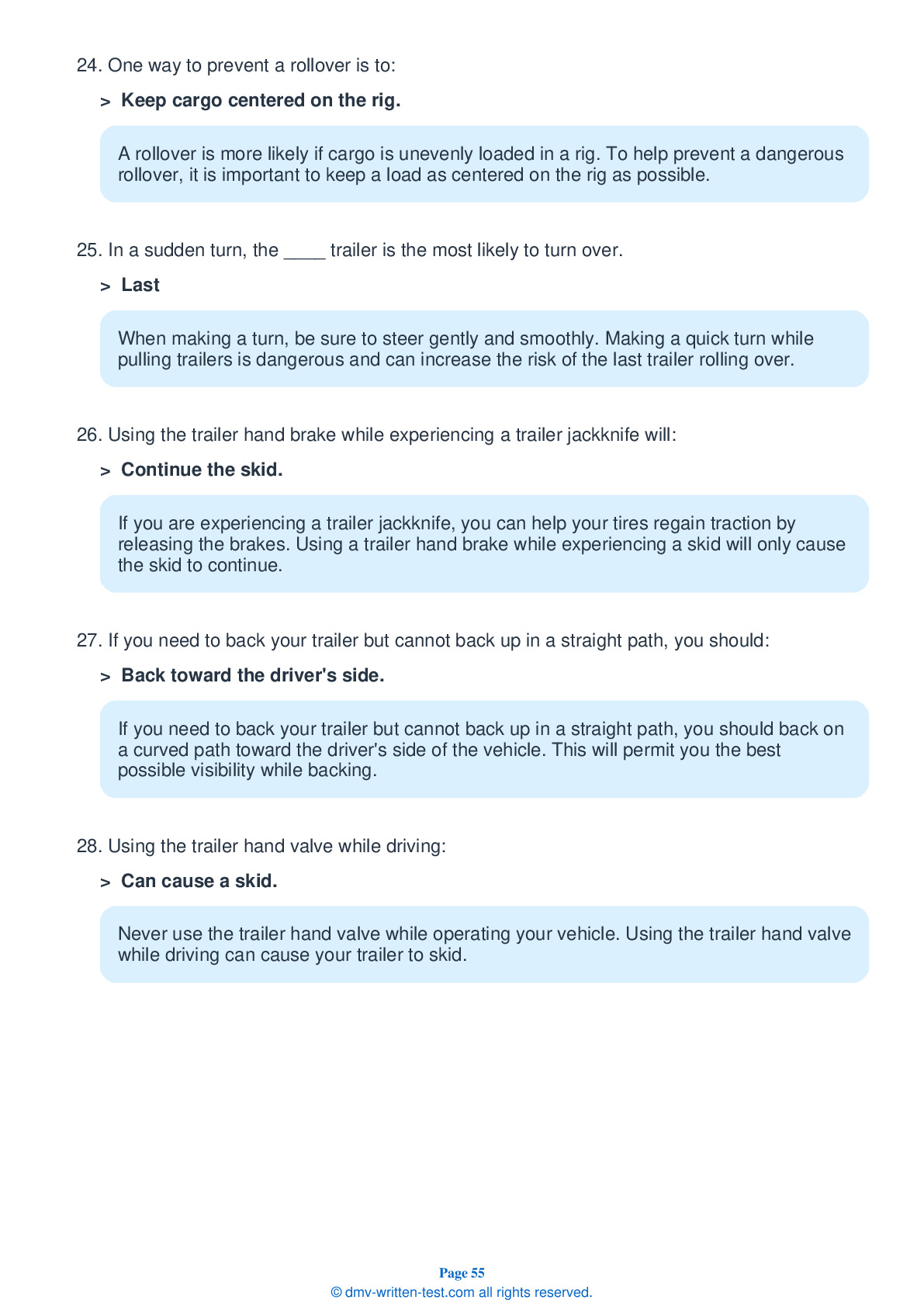
29. When backing with a trailer, turning toward the driver’s side is encouraged because:
Explanation
When driving in reverse, it is always recommended that a driver backs their vehicle toward its left side. This will allow the driver the best possible view of the rear of their vehicle.
30. On slippery roads, you should:
Explanation
On a slippery road, you must adjust your driving speed to fit conditions. Because it will take longer for your vehicle to stop on a slippery road than on a dry road, you should increase your following distance when conditions are slippery. Avoid driving in a way that requires you to change speeds frequently.
31. Why should the steps of a pre-trip inspection be done in the same order each time?
Explanation
Pre-trip inspections should be conducted in the same way every time. This will reinforce the steps, making it less likely that you will forget to inspect something important.
32. If other vehicles are having a difficult time getting around your truck on a road with two or more lanes, you should:
Explanation
You should stay in the right lane of a multilane road if your vehicle is being slowed down by a heavy load. Allow other vehicles to pass your truck using the left lane.
33. Cargo with a high center of gravity:
Explanation
Cargo with a high center of gravity makes a vehicle more likely to tip over than cargo with a low center of gravity. For this reason, it is important that the weight of cargo be distributed as low as possible.
34. Of the following, which is not a recommended way to spot potential signs of trouble?
Explanation
During a trip, you should regularly make checks to ensure that your vehicle is operating properly. Check the instrument panel and gauges; look at your mirrors; and examine the tires, cargo, and lights. Use all of your senses and be alert for anything that could be an early indication of trouble.
35. Before a trip, you should make sure that:
Explanation
When checking your vehicle's pedals during a pre-trip inspection, you should ensure that there is nothing under or around the pedals that will obstruct their use. Make sure the pedals are in proper working condition and that the surfaces of the pedals are grooved, if applicable.
Frequently Asked Questions
A Class A CDL (Commercial Driver's License) is a type of driver's license needed to operate a combination of vehicles with a total weight of 26,001 pounds or more, with the towed vehicle weighing more than 10,000 pounds. In Arizona, the Class A CDL is required for drivers who want to operate tractor-trailers, truck and trailer combinations, and other large commercial vehicles.
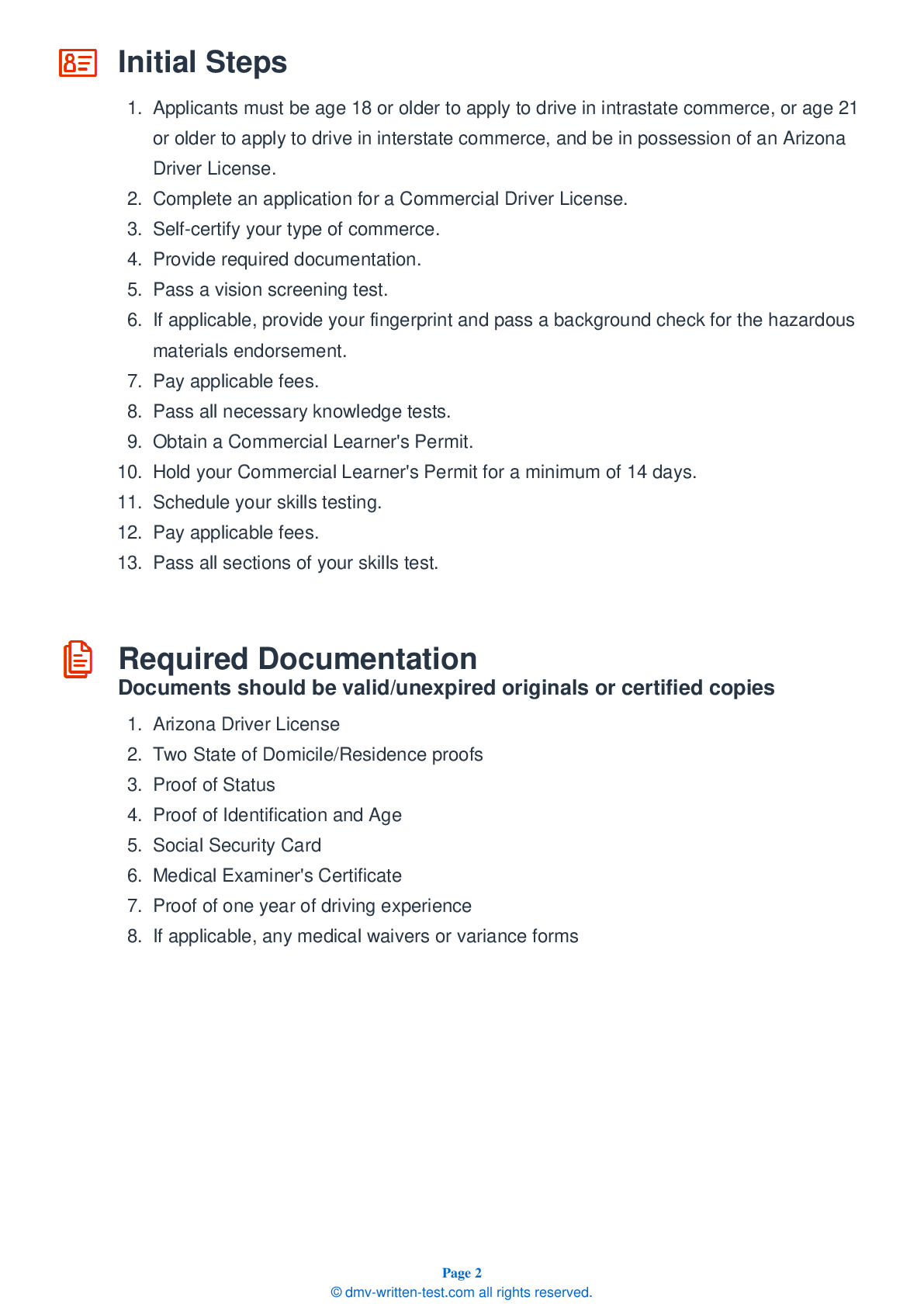
To obtain a Class A CDL in Arizona, here are the steps you need to follow:
1. Obtain a Commercial Learner's Permit (CLP) by passing the written knowledge test for the Class A CDL.
2. Hold the CLP for at least 14 days before taking the skills test.
3. Schedule and pass the three-part skills test, which includes a pre-trip inspection, basic vehicle control, and on-road driving.
4. Provide proof of identity and residency in Arizona.
5. Pass a medical exam and obtain a medical examiner's certificate.
6. Pay the applicable fees.
It's important to note that Arizona also requires Class A CDL holders to meet certain federal and state regulations, such as maintaining a valid medical certificate, adhering to hours-of-service rules, and complying with hazardous materials transportation requirements if applicable.
To obtain a Class A CDL in Arizona, here are the steps you need to follow:
1. Obtain a Commercial Learner's Permit (CLP) by passing the written knowledge test for the Class A CDL.
2. Hold the CLP for at least 14 days before taking the skills test.
3. Schedule and pass the three-part skills test, which includes a pre-trip inspection, basic vehicle control, and on-road driving.
4. Provide proof of identity and residency in Arizona.
5. Pass a medical exam and obtain a medical examiner's certificate.
6. Pay the applicable fees.
It's important to note that Arizona also requires Class A CDL holders to meet certain federal and state regulations, such as maintaining a valid medical certificate, adhering to hours-of-service rules, and complying with hazardous materials transportation requirements if applicable.
With a Class A CDL (Commercial Driver's License) in Arizona, you can operate a combination of vehicles with a total weight of 26,001 pounds or more, as long as the towed vehicle weighs more than 10,000 pounds. This includes tractor-trailers, truck and trailer combinations, and other large commercial vehicles.
Some examples of vehicles that you can operate with a Class A CDL in Arizona are:
- Tractor-trailers
- Semi-trucks
- Tanker trucks
- Livestock carriers
- Flatbed trucks with trailers
- Double or triple trailer combinations
- Car carriers
- Dump trucks with trailers
It's important to note that some Class A CDL endorsements may be required for certain types of vehicles or cargo. For example, you may need a hazmat endorsement to transport hazardous materials or a tanker endorsement to operate tanker trucks. Be sure to check with the Arizona Department of Transportation or a qualified CDL training school for more information on specific endorsements.
Some examples of vehicles that you can operate with a Class A CDL in Arizona are:
- Tractor-trailers
- Semi-trucks
- Tanker trucks
- Livestock carriers
- Flatbed trucks with trailers
- Double or triple trailer combinations
- Car carriers
- Dump trucks with trailers
It's important to note that some Class A CDL endorsements may be required for certain types of vehicles or cargo. For example, you may need a hazmat endorsement to transport hazardous materials or a tanker endorsement to operate tanker trucks. Be sure to check with the Arizona Department of Transportation or a qualified CDL training school for more information on specific endorsements.
To obtain a Class A CDL (Commercial Driver's License) in Arizona, you must meet the following requirements:
1. Age: You must be at least 18 years old to drive within the state of Arizona and at least 21 years old to drive across state lines or transport hazardous materials.
2. Valid driver's license: You must have a valid non-commercial driver's license issued by the state of Arizona.
3. Medical requirements: You must pass a medical examination by a certified medical examiner and obtain a medical examiner's certificate to prove that you are physically fit to operate a commercial vehicle.
4. Written test: You must pass a written knowledge test specific to the Class A CDL, which covers topics such as vehicle inspection, control and operation, and safe driving practices.
5. Commercial Learner's Permit (CLP): You must obtain a Commercial Learner's Permit by passing the written knowledge test for the Class A CDL. To get a CLP, you will also need to provide proof of identity and residency in Arizona.
6. Skills test: You must pass a three-part skills test that includes a pre-trip inspection, basic vehicle control, and on-road driving.
7. Fees: You must pay the applicable fees for your license and any endorsements or restrictions you may need.
It's important to note that additional endorsements may be required for certain types of vehicles or cargo, such as hazardous materials or tanker trucks. Be sure to check with the Arizona Department of Transportation or a qualified CDL training school for more information on specific endorsements and requirements.
1. Age: You must be at least 18 years old to drive within the state of Arizona and at least 21 years old to drive across state lines or transport hazardous materials.
2. Valid driver's license: You must have a valid non-commercial driver's license issued by the state of Arizona.
3. Medical requirements: You must pass a medical examination by a certified medical examiner and obtain a medical examiner's certificate to prove that you are physically fit to operate a commercial vehicle.
4. Written test: You must pass a written knowledge test specific to the Class A CDL, which covers topics such as vehicle inspection, control and operation, and safe driving practices.
5. Commercial Learner's Permit (CLP): You must obtain a Commercial Learner's Permit by passing the written knowledge test for the Class A CDL. To get a CLP, you will also need to provide proof of identity and residency in Arizona.
6. Skills test: You must pass a three-part skills test that includes a pre-trip inspection, basic vehicle control, and on-road driving.
7. Fees: You must pay the applicable fees for your license and any endorsements or restrictions you may need.
It's important to note that additional endorsements may be required for certain types of vehicles or cargo, such as hazardous materials or tanker trucks. Be sure to check with the Arizona Department of Transportation or a qualified CDL training school for more information on specific endorsements and requirements.
In Arizona, the minimum age requirement for a Class A CDL (Commercial Driver's License) is 18 years old. However, drivers who are 18 to 20 years old may only drive within the state of Arizona and are not allowed to transport hazardous materials or operate double or triple trailer combinations.
Drivers who are 21 years old or older may drive across state lines and transport hazardous materials, but they must also meet additional federal requirements, such as obtaining a Transportation Security Administration (TSA) clearance and passing a background check.
It's important to note that some companies may have their own age requirements for drivers, even if the driver meets the state and federal requirements. Be sure to check with your employer or prospective employers for any additional age restrictions.
Drivers who are 21 years old or older may drive across state lines and transport hazardous materials, but they must also meet additional federal requirements, such as obtaining a Transportation Security Administration (TSA) clearance and passing a background check.
It's important to note that some companies may have their own age requirements for drivers, even if the driver meets the state and federal requirements. Be sure to check with your employer or prospective employers for any additional age restrictions.
Yes, you may need endorsements for certain types of vehicles or cargo that you plan to transport with your Class A CDL (Commercial Driver's License) in Arizona. The following are some of the endorsements that may be required:
1. Hazmat endorsement: This endorsement is required to transport hazardous materials, such as explosives, gases, flammable and combustible liquids and solids, and radioactive materials.
2. Tanker endorsement: This endorsement is required to transport liquid or gaseous materials in tank vehicles.
3. Double/triple trailer endorsement: This endorsement is required to operate double or triple trailer combinations.
4. Passenger endorsement: This endorsement is required to operate a vehicle designed to transport 16 or more passengers, including the driver.
5. School bus endorsement: This endorsement is required to operate a school bus.
To obtain an endorsement, you will need to pass an additional written knowledge test and meet any other requirements set forth by the Arizona Department of Transportation. It's important to note that some employers may require additional endorsements beyond what is legally required by the state or federal government. Be sure to check with your employer or prospective employers for any additional endorsements you may need.
1. Hazmat endorsement: This endorsement is required to transport hazardous materials, such as explosives, gases, flammable and combustible liquids and solids, and radioactive materials.
2. Tanker endorsement: This endorsement is required to transport liquid or gaseous materials in tank vehicles.
3. Double/triple trailer endorsement: This endorsement is required to operate double or triple trailer combinations.
4. Passenger endorsement: This endorsement is required to operate a vehicle designed to transport 16 or more passengers, including the driver.
5. School bus endorsement: This endorsement is required to operate a school bus.
To obtain an endorsement, you will need to pass an additional written knowledge test and meet any other requirements set forth by the Arizona Department of Transportation. It's important to note that some employers may require additional endorsements beyond what is legally required by the state or federal government. Be sure to check with your employer or prospective employers for any additional endorsements you may need.
The Class A CDL (Commercial Driver's License) skills test in Arizona consists of three parts: a pre-trip inspection, a basic vehicle control test, and an on-road driving test. Here is a breakdown of each part:
1. Pre-trip inspection: You will be required to inspect the vehicle to make sure it is safe to operate. You will need to identify and explain any issues or potential issues with the vehicle's systems, such as brakes, tires, lights, and coupling devices.
2. Basic vehicle control test: You will be required to demonstrate your ability to control the vehicle in a controlled environment. This may include maneuvers such as straight-line backing, offset backing, parallel parking, and alley docking.
3. On-road driving test: You will be required to demonstrate your ability to safely operate the vehicle on public roads. This may include merging onto a highway, changing lanes, making turns, and obeying traffic signals and signs.
During the skills test, you will be evaluated on your ability to safely operate the vehicle and follow all traffic laws and regulations. You will also be scored on your performance during each part of the test. To pass the Class A CDL skills test in Arizona, you must achieve a passing score on each part of the test.
1. Pre-trip inspection: You will be required to inspect the vehicle to make sure it is safe to operate. You will need to identify and explain any issues or potential issues with the vehicle's systems, such as brakes, tires, lights, and coupling devices.
2. Basic vehicle control test: You will be required to demonstrate your ability to control the vehicle in a controlled environment. This may include maneuvers such as straight-line backing, offset backing, parallel parking, and alley docking.
3. On-road driving test: You will be required to demonstrate your ability to safely operate the vehicle on public roads. This may include merging onto a highway, changing lanes, making turns, and obeying traffic signals and signs.
During the skills test, you will be evaluated on your ability to safely operate the vehicle and follow all traffic laws and regulations. You will also be scored on your performance during each part of the test. To pass the Class A CDL skills test in Arizona, you must achieve a passing score on each part of the test.
Yes, there are certain restrictions and limitations for drivers with a Class A CDL (Commercial Driver's License) license in Arizona. Here are some examples:
1. Age restrictions: To obtain a Class A CDL in Arizona, you must be at least 18 years old. However, drivers under the age of 21 are limited to intrastate driving only.
2. Endorsement restrictions: As mentioned earlier, certain endorsements may be required to operate certain types of vehicles or cargo. If you do not have the required endorsement, you will be restricted from operating that type of vehicle or cargo.
3. Vehicle type restrictions: Some Class A CDL holders may be restricted from operating certain types of vehicles, such as those with manual transmissions or air brakes.
4. Special conditions restrictions: Some drivers may be subject to special conditions due to medical or other factors that may affect their ability to operate a commercial vehicle safely.
It's important to note that violating any of these restrictions or limitations can result in penalties such as fines, license suspension, or even disqualification from driving a commercial vehicle. It's important for all commercial drivers to understand and comply with these restrictions and limitations at all times.
1. Age restrictions: To obtain a Class A CDL in Arizona, you must be at least 18 years old. However, drivers under the age of 21 are limited to intrastate driving only.
2. Endorsement restrictions: As mentioned earlier, certain endorsements may be required to operate certain types of vehicles or cargo. If you do not have the required endorsement, you will be restricted from operating that type of vehicle or cargo.
3. Vehicle type restrictions: Some Class A CDL holders may be restricted from operating certain types of vehicles, such as those with manual transmissions or air brakes.
4. Special conditions restrictions: Some drivers may be subject to special conditions due to medical or other factors that may affect their ability to operate a commercial vehicle safely.
It's important to note that violating any of these restrictions or limitations can result in penalties such as fines, license suspension, or even disqualification from driving a commercial vehicle. It's important for all commercial drivers to understand and comply with these restrictions and limitations at all times.
In Arizona, the Class A CDL (Commercial Driver's License) written test is available in English and Spanish. You may take the test in either language, depending on your preference and ability.
However, it's important to note that if you choose to take the test in a language other than English, you may be required to bring a translator with you to the testing center. The translator must be able to accurately translate the questions and your answers from English to the other language and vice versa.
Additionally, it's important to understand that while the written test may be available in multiple languages, the skills test is only available in English. This means that you must be able to communicate effectively in English during the skills test and follow instructions given by the examiner.
Overall, if you feel more comfortable taking the written test in a language other than English, you should do so. Just make sure you have a qualified translator with you if necessary and that you are prepared to communicate in English during the skills test.
However, it's important to note that if you choose to take the test in a language other than English, you may be required to bring a translator with you to the testing center. The translator must be able to accurately translate the questions and your answers from English to the other language and vice versa.
Additionally, it's important to understand that while the written test may be available in multiple languages, the skills test is only available in English. This means that you must be able to communicate effectively in English during the skills test and follow instructions given by the examiner.
Overall, if you feel more comfortable taking the written test in a language other than English, you should do so. Just make sure you have a qualified translator with you if necessary and that you are prepared to communicate in English during the skills test.
Yes, you may request accommodations for the Class A CDL (Commercial Driver's License) written test in Arizona if you have a disability that would affect your ability to take the test under standard conditions. The Arizona Department of Transportation (ADOT) is committed to providing reasonable accommodations to ensure that all individuals have an equal opportunity to obtain a CDL.
To request accommodations, you will need to fill out a Request for Reasonable Accommodation form and submit it to ADOT. The form is available on the ADOT website or can be obtained by contacting ADOT directly.
Some examples of accommodations that may be available include:
- Providing a reader or scribe to assist with reading or writing the test
- Allowing extra time for the test
- Providing a separate testing room or special seating arrangements
- Providing assistive technology or other aids and services as needed
Once your request has been received, ADOT will review it and determine what accommodations can be provided based on your specific needs. It's important to submit your request as soon as possible so that ADOT has adequate time to make any necessary arrangements.
Overall, if you have a disability that would affect your ability to take the Class A CDL written test under standard conditions, you should not hesitate to request accommodations. ADOT is committed to providing equal access to all individuals and will work with you to ensure that you have an opportunity to obtain a CDL.
To request accommodations, you will need to fill out a Request for Reasonable Accommodation form and submit it to ADOT. The form is available on the ADOT website or can be obtained by contacting ADOT directly.
Some examples of accommodations that may be available include:
- Providing a reader or scribe to assist with reading or writing the test
- Allowing extra time for the test
- Providing a separate testing room or special seating arrangements
- Providing assistive technology or other aids and services as needed
Once your request has been received, ADOT will review it and determine what accommodations can be provided based on your specific needs. It's important to submit your request as soon as possible so that ADOT has adequate time to make any necessary arrangements.
Overall, if you have a disability that would affect your ability to take the Class A CDL written test under standard conditions, you should not hesitate to request accommodations. ADOT is committed to providing equal access to all individuals and will work with you to ensure that you have an opportunity to obtain a CDL.
If you fail the Class A CDL (Commercial Driver's License) written test in Arizona, you may retake the test after a certain period of time. The waiting period depends on how many times you have failed the test:
- First failure: You may retake the test after 1 business day.
- Second failure: You must wait 7 business days before retaking the test.
- Third and subsequent failures: You must wait 14 business days before retaking the test.
Note that these waiting periods apply to each individual test attempt, not to the overall number of times you have taken the test. For example, if you fail the test twice in a row, you must wait 7 business days before your second retake, even if you passed on your first attempt.
Additionally, each time you retake the test, you will be required to pay a fee. The fee for the Class A CDL written test in Arizona is currently $10.
It's important to note that while there is no limit to the number of times you may retake the written test, it's a good idea to study and prepare thoroughly before each attempt. If you continue to struggle with passing the test, consider seeking additional resources such as study materials or classes to help improve your knowledge and skills.
- First failure: You may retake the test after 1 business day.
- Second failure: You must wait 7 business days before retaking the test.
- Third and subsequent failures: You must wait 14 business days before retaking the test.
Note that these waiting periods apply to each individual test attempt, not to the overall number of times you have taken the test. For example, if you fail the test twice in a row, you must wait 7 business days before your second retake, even if you passed on your first attempt.
Additionally, each time you retake the test, you will be required to pay a fee. The fee for the Class A CDL written test in Arizona is currently $10.
It's important to note that while there is no limit to the number of times you may retake the written test, it's a good idea to study and prepare thoroughly before each attempt. If you continue to struggle with passing the test, consider seeking additional resources such as study materials or classes to help improve your knowledge and skills.
