Knowledge Test Class A
This license is required for driving any legal combination of vehicles, with a gross combination weight rating of 26,001 pounds or more, provided the GVWR of a trailer exceeds 10,000 pounds To receive this license, applicants must pass a 50-question test. To pass, applicants must answer 40 questions correctly. Each question has three possible answer choices. Test questions come from the Oklahoma Commercial Driver License Manual. Questions come from chapters covering: Introduction, Driving Safely, Transporting Cargo Safely, Air Brakes (if applicable), Combination, Doubles and Hazardous Materials. Endorsements that may be used with a Class A CDL are: Hazardous materials, Tank, Passenger, HazMat and Tank, Air Brakes and School bus.
Number of Question
Passing Score
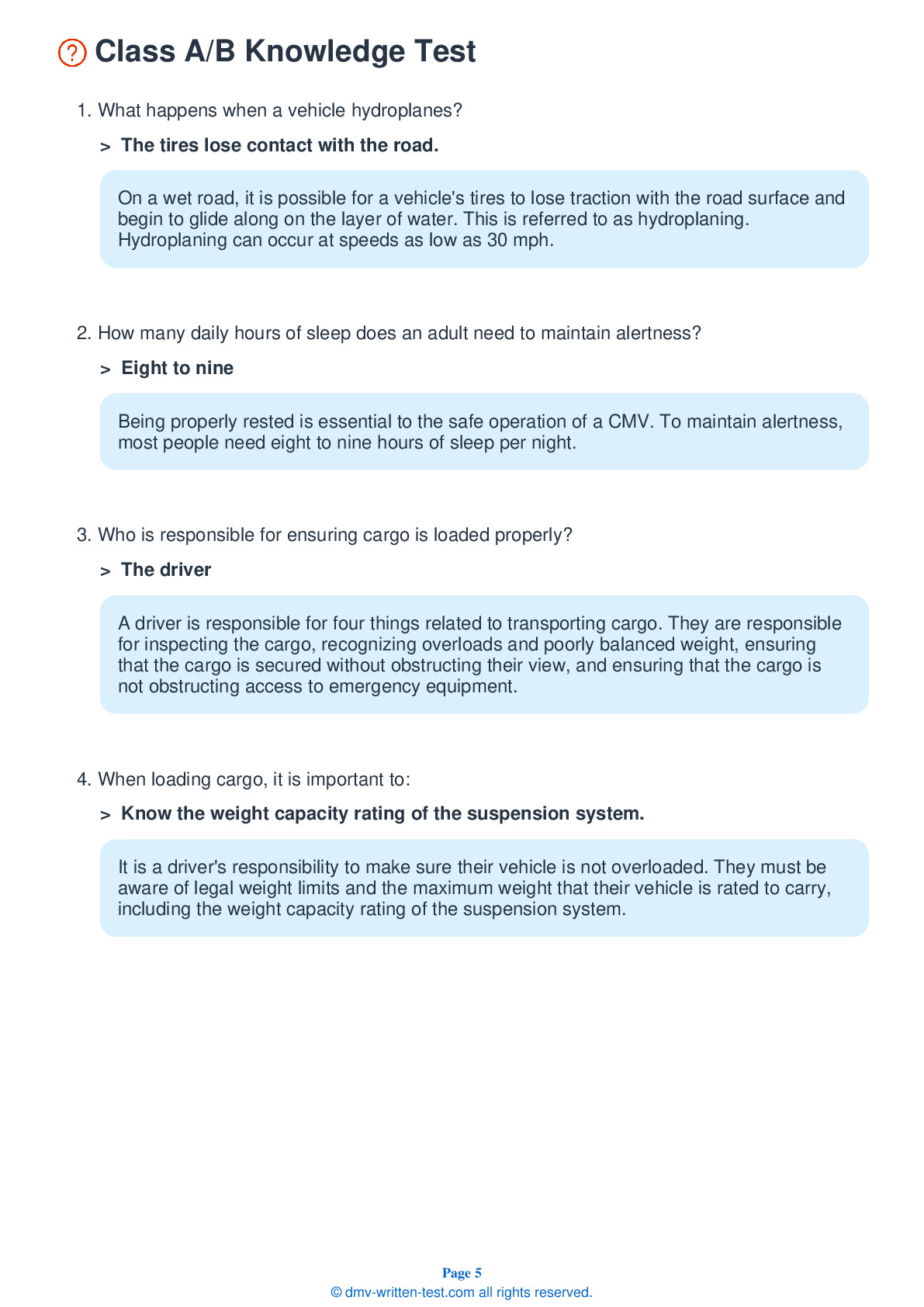
8. When an engine is running, an acceptable oil pressure would be:
Explanation
Operating oil pressure should be between 35 and 75 psi. Do not operate a vehicle if it has oil pressure that is low, dropping, or fluctuating.
9. When drivers turn, they usually:
Explanation
When turning, drivers usually look in the direction of their turn. If a driver fails to signal before a turn or lane change, their body movements may still provide a clue that they are planning to turn.
10. Brake linings should be:
Explanation
Brake linings should not be loose or soaked with oil or grease. They shouldn't be dangerously thin.
11. When adjusting your mirrors before a trip:
Explanation
When properly adjusted, your mirrors should each display some part of your vehicle. Being able to see your own vehicle in your mirrors will give you a point of reference when judging the positions of other objects.
12. When a vehicle is started, the coolant temperature should:
Explanation
After an engine is started, the coolant temperature should begin a gradual rise toward the normal operating range.
13. If an aggressive driver is involved in a crash on the road ahead, you should:
Explanation
If you see a crash involving an aggressive driver, you should stop a safe distance from the crash scene, wait for police to arrive, and inform them of the aggressive behavior you witnessed.
14. If you remain in neutral for too long while switching gears:
Explanation
If you remain in neutral for too long while switching gears, you may have difficulty putting the vehicle into the next gear. If this happens, do not try to force the gear shift. Instead, return to neutral, release the clutch, increase the engine speed to match the road speed, and try again.

Frequently Asked Questions
A Class A Commercial Driver's License (CDL) is required for drivers who operate a combination of vehicles with a total weight of 26,001 pounds or more. This includes towing a vehicle or trailer that weighs more than 10,000 pounds. In Oklahoma, a Class A CDL license allows drivers to operate vehicles such as tractor-trailers, tanker trucks, livestock carriers, and flatbeds.
To obtain a Class A CDL license in Oklahoma, you must meet the following requirements:
1. Be at least 18 years of age to drive within the state of Oklahoma and 21 years of age to drive interstate.
2. Possess a valid Oklahoma driver's license.
3. Obtain a medical certificate that meets federal standards.
4. Pass a written knowledge test specific to commercial driving.
5. Pass a skills test which includes a pre-trip inspection, basic control skills, and an on-road driving test.
Additionally, you may be required to complete additional endorsements for certain types of vehicles or cargo such as hazardous materials (Hazmat), passenger transport (P), and double/triple trailers (T).
To obtain a Class A CDL license in Oklahoma, you must meet the following requirements:
1. Be at least 18 years of age to drive within the state of Oklahoma and 21 years of age to drive interstate.
2. Possess a valid Oklahoma driver's license.
3. Obtain a medical certificate that meets federal standards.
4. Pass a written knowledge test specific to commercial driving.
5. Pass a skills test which includes a pre-trip inspection, basic control skills, and an on-road driving test.
Additionally, you may be required to complete additional endorsements for certain types of vehicles or cargo such as hazardous materials (Hazmat), passenger transport (P), and double/triple trailers (T).
With a Class A Commercial Driver's License (CDL) in Oklahoma, you are authorized to operate combination vehicles where the total weight of the vehicle being towed is more than 10,000 pounds. This includes:
1. Tractor-trailers: A tractor-trailer is a combination of a semi-truck (tractor) and a trailer that carries freight or cargo.
2. Livestock carriers: A livestock carrier is used to transport animals such as cattle, horses, and pigs.
3. Tanker trucks: A tanker truck is used to transport liquids or gases such as fuel, water, or chemicals.
4. Flatbeds: A flatbed is a type of trailer that has an open top and a flat surface for carrying cargo.
5. Double and triple trailers: Double and triple trailers are two or three trailers attached to the back of a semi-truck.
However, it's important to note that you may need additional endorsements for certain types of cargo such as hazardous materials (Hazmat) or passenger transport (P).
1. Tractor-trailers: A tractor-trailer is a combination of a semi-truck (tractor) and a trailer that carries freight or cargo.
2. Livestock carriers: A livestock carrier is used to transport animals such as cattle, horses, and pigs.
3. Tanker trucks: A tanker truck is used to transport liquids or gases such as fuel, water, or chemicals.
4. Flatbeds: A flatbed is a type of trailer that has an open top and a flat surface for carrying cargo.
5. Double and triple trailers: Double and triple trailers are two or three trailers attached to the back of a semi-truck.
However, it's important to note that you may need additional endorsements for certain types of cargo such as hazardous materials (Hazmat) or passenger transport (P).
To obtain a Class A Commercial Driver's License (CDL) in Oklahoma, you must meet the following requirements:
1. Be at least 18 years of age to drive within the state of Oklahoma and 21 years of age to drive interstate.
2. Possess a valid Oklahoma driver's license.
3. Obtain a medical certificate that meets federal standards. You can get this certificate by passing a physical examination from a licensed medical examiner.
4. Pass a written knowledge test specific to commercial driving. The test covers topics such as vehicle safety, transporting cargo safely, and driving techniques.
5. Pass a skills test which includes a pre-trip inspection, basic control skills, and an on-road driving test. The skills test will be conducted by a licensed examiner.
6. Provide proof of citizenship or legal presence in the United States.
7. Pay the appropriate fees for the license and endorsements you are seeking.
It's important to note that additional endorsements may be required for certain types of vehicles or cargo such as hazardous materials (Hazmat), passenger transport (P), and double/triple trailers (T). To obtain these endorsements, you will need to pass additional knowledge tests and meet additional requirements.
1. Be at least 18 years of age to drive within the state of Oklahoma and 21 years of age to drive interstate.
2. Possess a valid Oklahoma driver's license.
3. Obtain a medical certificate that meets federal standards. You can get this certificate by passing a physical examination from a licensed medical examiner.
4. Pass a written knowledge test specific to commercial driving. The test covers topics such as vehicle safety, transporting cargo safely, and driving techniques.
5. Pass a skills test which includes a pre-trip inspection, basic control skills, and an on-road driving test. The skills test will be conducted by a licensed examiner.
6. Provide proof of citizenship or legal presence in the United States.
7. Pay the appropriate fees for the license and endorsements you are seeking.
It's important to note that additional endorsements may be required for certain types of vehicles or cargo such as hazardous materials (Hazmat), passenger transport (P), and double/triple trailers (T). To obtain these endorsements, you will need to pass additional knowledge tests and meet additional requirements.
In Oklahoma, the minimum age requirement for a Class A Commercial Driver's License (CDL) is 18 years old. However, if you plan to operate a commercial vehicle across state lines or transport hazardous materials, you must be at least 21 years old.
It's important to note that some employers may have their own age requirements for CDL drivers, and certain endorsements such as the Passenger (P) endorsement require the driver to be at least 21 years old.
It's important to note that some employers may have their own age requirements for CDL drivers, and certain endorsements such as the Passenger (P) endorsement require the driver to be at least 21 years old.
Depending on the type of vehicle you plan to operate and the cargo you plan to transport, you may need additional endorsements on your Class A Commercial Driver's License (CDL). The following endorsements are available in Oklahoma:
1. Double/Triple Trailer (T) Endorsement: Required for drivers who will be operating double or triple trailers.
2. Hazardous Materials (H) Endorsement: Required for drivers who will be transporting hazardous materials.
3. Tank Vehicle (N) Endorsement: Required for drivers who will be operating vehicles designed to transport liquids or gases in bulk containers.
4. Passenger (P) Endorsement: Required for drivers who will be transporting passengers in a commercial vehicle, such as a bus or a van.
5. School Bus (S) Endorsement: Required for drivers who will be operating a school bus.
To obtain these endorsements, you will need to pass additional knowledge tests and meet additional requirements. It is important to note that some employers may require their drivers to have specific endorsements beyond what is legally required by the state.
1. Double/Triple Trailer (T) Endorsement: Required for drivers who will be operating double or triple trailers.
2. Hazardous Materials (H) Endorsement: Required for drivers who will be transporting hazardous materials.
3. Tank Vehicle (N) Endorsement: Required for drivers who will be operating vehicles designed to transport liquids or gases in bulk containers.
4. Passenger (P) Endorsement: Required for drivers who will be transporting passengers in a commercial vehicle, such as a bus or a van.
5. School Bus (S) Endorsement: Required for drivers who will be operating a school bus.
To obtain these endorsements, you will need to pass additional knowledge tests and meet additional requirements. It is important to note that some employers may require their drivers to have specific endorsements beyond what is legally required by the state.
The Class A Commercial Driver's License (CDL) skills test consists of three parts: pre-trip inspection, basic vehicle control, and on-road driving.
1. Pre-Trip Inspection: You will be required to perform a thorough inspection of your vehicle to ensure that it is safe to operate. This includes checking the engine compartment, the cab, and the trailer.
2. Basic Vehicle Control: You will be tested on your ability to control your vehicle in various situations, such as backing up or turning around in a tight space. You will also be required to demonstrate your ability to couple and uncouple the trailer.
3. On-Road Driving: You will be evaluated on your driving skills as you operate the vehicle on public roads. This includes merging onto highways, changing lanes, and making turns.
It's important to note that the test is typically conducted in a large commercial vehicle, such as a tractor-trailer or a combination truck. You will need to demonstrate that you can operate this type of vehicle safely and effectively in various situations.
To pass the skills test, you must demonstrate proficiency in all three areas and meet all of the requirements set by the Oklahoma Department of Public Safety (DPS).
1. Pre-Trip Inspection: You will be required to perform a thorough inspection of your vehicle to ensure that it is safe to operate. This includes checking the engine compartment, the cab, and the trailer.
2. Basic Vehicle Control: You will be tested on your ability to control your vehicle in various situations, such as backing up or turning around in a tight space. You will also be required to demonstrate your ability to couple and uncouple the trailer.
3. On-Road Driving: You will be evaluated on your driving skills as you operate the vehicle on public roads. This includes merging onto highways, changing lanes, and making turns.
It's important to note that the test is typically conducted in a large commercial vehicle, such as a tractor-trailer or a combination truck. You will need to demonstrate that you can operate this type of vehicle safely and effectively in various situations.
To pass the skills test, you must demonstrate proficiency in all three areas and meet all of the requirements set by the Oklahoma Department of Public Safety (DPS).
Yes, there are restrictions or limitations for drivers with a Class A Commercial Driver's License (CDL) in Oklahoma. Some of the restrictions or limitations include:
1. Age: To obtain a Class A CDL license, you must be at least 18 years old. However, if you plan to transport hazardous materials or operate across state lines, you must be at least 21 years old.
2. Endorsements: As mentioned earlier, you may need additional endorsements on your Class A CDL license to operate certain types of vehicles or transport certain types of cargo. You must obtain the required endorsements before operating these vehicles.
3. Weight and Size Limits: There are weight and size limits for commercial vehicles in Oklahoma. You must comply with these limits when operating your vehicle.
4. Hours of Service: Federal and state regulations limit the amount of time that commercial drivers can spend on the road before taking a break or rest. You must comply with these regulations to avoid violations.
5. Medical Requirements: Commercial drivers must meet certain medical requirements to obtain and maintain their CDL license. These requirements include regular physical exams and adherence to certain health standards.
It's important to note that violating any of these restrictions or limitations can result in fines, penalties, and even the suspension or revocation of your CDL license.
1. Age: To obtain a Class A CDL license, you must be at least 18 years old. However, if you plan to transport hazardous materials or operate across state lines, you must be at least 21 years old.
2. Endorsements: As mentioned earlier, you may need additional endorsements on your Class A CDL license to operate certain types of vehicles or transport certain types of cargo. You must obtain the required endorsements before operating these vehicles.
3. Weight and Size Limits: There are weight and size limits for commercial vehicles in Oklahoma. You must comply with these limits when operating your vehicle.
4. Hours of Service: Federal and state regulations limit the amount of time that commercial drivers can spend on the road before taking a break or rest. You must comply with these regulations to avoid violations.
5. Medical Requirements: Commercial drivers must meet certain medical requirements to obtain and maintain their CDL license. These requirements include regular physical exams and adherence to certain health standards.
It's important to note that violating any of these restrictions or limitations can result in fines, penalties, and even the suspension or revocation of your CDL license.
In Oklahoma, the Class A Commercial Driver's License (CDL) written test is offered in English only. The Oklahoma Department of Public Safety (DPS) requires that all applicants for a CDL license demonstrate proficiency in English.
This means that you must be able to read and understand road signs, communicate effectively with law enforcement officials, and understand safety instructions. If you are unable to demonstrate proficiency in English, you may not be eligible for a CDL license.
However, if you have difficulty understanding the written test due to a disability, you may request reasonable accommodations such as an oral exam or an interpreter. You must make this request at least 30 days before your scheduled test date and provide documentation of your disability.
This means that you must be able to read and understand road signs, communicate effectively with law enforcement officials, and understand safety instructions. If you are unable to demonstrate proficiency in English, you may not be eligible for a CDL license.
However, if you have difficulty understanding the written test due to a disability, you may request reasonable accommodations such as an oral exam or an interpreter. You must make this request at least 30 days before your scheduled test date and provide documentation of your disability.
Yes, if you have a disability that makes it difficult for you to take the Class A Commercial Driver's License (CDL) written test, you may request accommodations. The Oklahoma Department of Public Safety (DPS) provides reasonable accommodations for individuals with disabilities in accordance with the Americans with Disabilities Act (ADA).
Examples of accommodations that may be provided include a reader, a sign language interpreter, or a written test in an alternative format. To request accommodations, you must contact the DPS at least 30 days before your scheduled test date and provide documentation of your disability.
The documentation must be from a qualified professional and must include:
- A specific diagnosis of your disability
- How your disability affects your ability to take the written test
- The recommended accommodations that would allow you to take the test
The DPS will review your request and determine what accommodations are appropriate based on your specific needs. It's important to note that the DPS may deny a request for accommodations if they determine that it would fundamentally alter the nature of the test or create an undue burden on the agency.
Examples of accommodations that may be provided include a reader, a sign language interpreter, or a written test in an alternative format. To request accommodations, you must contact the DPS at least 30 days before your scheduled test date and provide documentation of your disability.
The documentation must be from a qualified professional and must include:
- A specific diagnosis of your disability
- How your disability affects your ability to take the written test
- The recommended accommodations that would allow you to take the test
The DPS will review your request and determine what accommodations are appropriate based on your specific needs. It's important to note that the DPS may deny a request for accommodations if they determine that it would fundamentally alter the nature of the test or create an undue burden on the agency.
If you fail the Class A Commercial Driver's License (CDL) written test in Oklahoma, you can retake the test. However, you must wait at least one business day before retaking the test and you will need to pay the testing fee again.
It's important to note that you have a limited number of attempts to pass the written test. In Oklahoma, you are allowed three attempts to pass the written test within a 180-day period. If you fail all three attempts, you must wait at least 30 days before testing again.
It's also worth noting that if you fail the written test, you may want to consider taking a Class A CDL training course to help prepare for the test. These courses can provide valuable information and practice tests to help you pass the test on your next attempt.
It's important to note that you have a limited number of attempts to pass the written test. In Oklahoma, you are allowed three attempts to pass the written test within a 180-day period. If you fail all three attempts, you must wait at least 30 days before testing again.
It's also worth noting that if you fail the written test, you may want to consider taking a Class A CDL training course to help prepare for the test. These courses can provide valuable information and practice tests to help you pass the test on your next attempt.
