Knowledge Test Class A
This license is required for driving any legal combination of vehicles, with a gross combination weight rating of 26,001 pounds or more, provided the GVWR of a trailer exceeds 10,000 pounds To receive this license, applicants must pass a 50-question test. To pass, applicants must answer 40 questions correctly. Each question has three or four possible answer choices. Test questions come from the Montana Commercial Driver License Manual. Questions come from chapters covering: Introduction, Driving Safely, Transporting Cargo Safely, Air Brakes (if applicable), Combination, Doubles and Hazardous Materials. Endorsements that may be used with a Class A CDL are: Hazardous materials, Tank, Passenger, HazMat and Tank, Air Brakes and School bus.
Number of Question
Passing Score
15. When traveling down a hill:
Explanation
When a vehicle is traveling on a downward slope, the force of gravity will cause its speed to increase.
16. In a vehicle with dual parking control valves, once air pressure is lost and the spring brakes come on:
Explanation
In a vehicle with dual parking control valves, there is a separate air tank that can be used to temporarily release the spring brakes if they have been activated due to low air pressure. Pushing in the proper control will release the spring brakes for a short period of time, allowing the driver to move the vehicle in an emergency.
17. During a basic vehicle control skills test, you may be asked to:
Explanation
Maneuvers that may be included in the basic vehicle control skills test include straight line backing, offset back/right parking, offset back/left parking, driver side parallel parking, conventional parallel parking, and alley docking.
18. Your horn should be used to:
Explanation
Your vehicle's horn is a tool to warn others of your presence. Because the horn may create danger by startling other drivers, you should use it only if necessary.
19. ____ make up the emergency brake system.
Explanation
In an air brake system, there are three different braking systems: a service brake system, a parking brake system, and an emergency brake system. The emergency brake system uses parts of both the parking and service brake systems.
20. A driver should ensure that:
Explanation
It is essential to the safe operation of a CMV that cargo be properly loaded. Improper loading can affect handling and damage the vehicle. Additionally, improperly loaded materials can cause injury or death by falling off of the vehicle.
21. Most drivers are the least alert:
Explanation
Fatigue and lack of alertness are major hazards when driving at night. Most people are the least alert at night, especially after midnight.

Frequently Asked Questions
A Class A Commercial Driver's License (CDL) in Montana allows drivers to operate a combination of vehicles with a total weight of 26,001 pounds or more, provided the weight of the vehicle(s) being towed is more than 10,000 pounds. This license is required for drivers who operate tractor-trailers, tanker trucks, livestock carriers, and flatbeds with trailers, among other vehicles.
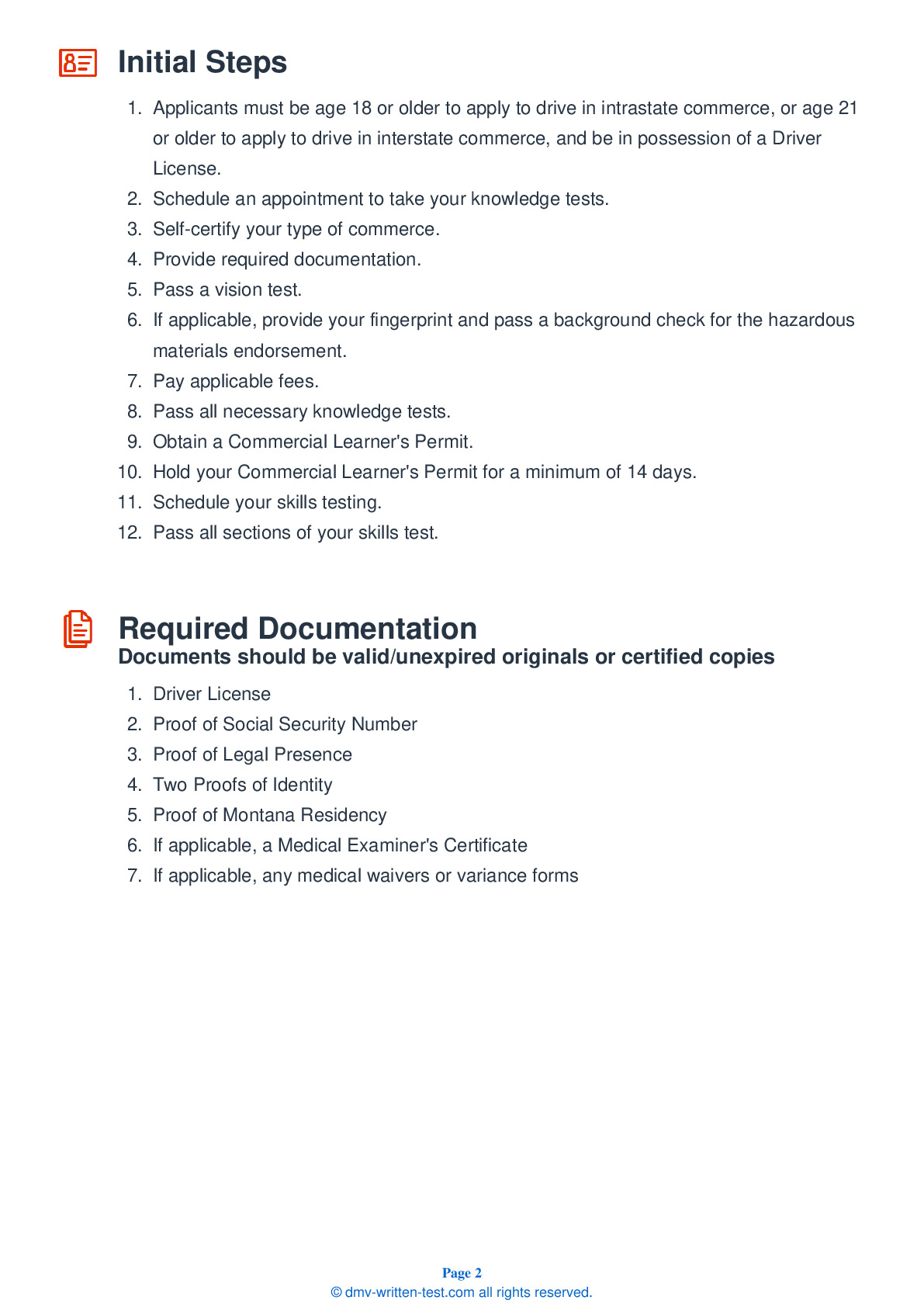
Here are the steps to obtain a Class A CDL license in Montana:
1. Obtain a Montana Commercial Driver's License (CDL) Manual and study it thoroughly.
2. Obtain a Montana CDL learner's permit by passing a written knowledge test at a Montana Motor Vehicle Division (MVD) office.
3. Get behind-the-wheel training from a qualified instructor or employer who has a Class A CDL license.
4. Schedule and pass a Class A CDL skills test at a Montana-approved testing facility.
5. Once you pass the skills test, return to the MVD office to obtain your Class A CDL license.
It is important to note that there may be additional requirements for obtaining a Class A CDL license in Montana, such as providing proof of residency and passing a medical exam. It is recommended to check with the MVD for specific requirements and details.
Here are the steps to obtain a Class A CDL license in Montana:
1. Obtain a Montana Commercial Driver's License (CDL) Manual and study it thoroughly.
2. Obtain a Montana CDL learner's permit by passing a written knowledge test at a Montana Motor Vehicle Division (MVD) office.
3. Get behind-the-wheel training from a qualified instructor or employer who has a Class A CDL license.
4. Schedule and pass a Class A CDL skills test at a Montana-approved testing facility.
5. Once you pass the skills test, return to the MVD office to obtain your Class A CDL license.
It is important to note that there may be additional requirements for obtaining a Class A CDL license in Montana, such as providing proof of residency and passing a medical exam. It is recommended to check with the MVD for specific requirements and details.
With a Class A CDL license in Montana, you can operate a combination of vehicles with a total weight of 26,001 pounds or more, provided the weight of the vehicle(s) being towed is more than 10,000 pounds. This includes:
1. Tractor-trailers
2. Livestock carriers
3. Tanker trucks
4. Flatbeds with trailers
5. Double and triple trailers
6. Combination vehicles with a gross vehicle weight rating (GVWR) of 26,001 pounds or more
It is important to note that some employers may require additional endorsements for specific types of vehicles or cargo, such as hazardous materials or passenger transport. Therefore, it is recommended to check with your employer or the Montana Motor Vehicle Division (MVD) for specific requirements and endorsements needed for your job.
1. Tractor-trailers
2. Livestock carriers
3. Tanker trucks
4. Flatbeds with trailers
5. Double and triple trailers
6. Combination vehicles with a gross vehicle weight rating (GVWR) of 26,001 pounds or more
It is important to note that some employers may require additional endorsements for specific types of vehicles or cargo, such as hazardous materials or passenger transport. Therefore, it is recommended to check with your employer or the Montana Motor Vehicle Division (MVD) for specific requirements and endorsements needed for your job.
To obtain a Class A CDL license in Montana, you must meet the following requirements:
1. Age: You must be at least 18 years old to obtain a Class A CDL license. However, if you plan to operate a commercial vehicle across state lines or transport hazardous materials, you must be at least 21 years old.
2. Valid Montana driver's license: You must have a valid Montana driver's license.
3. Medical certification: You must pass a medical exam and obtain a medical certificate from a certified medical examiner to prove that you are physically qualified to operate a commercial vehicle.
4. Commercial Driver's License Manual: You are required to study the Montana Commercial Driver's License Manual and pass a written knowledge test at a Montana Motor Vehicle Division (MVD) office to obtain a CDL learner's permit.
5. Behind-the-wheel training: You must complete behind-the-wheel training in a Class A commercial vehicle from a qualified instructor or employer who has a Class A CDL license.
6. Skills Test: After completing the behind-the-wheel training, you must schedule and pass a Class A CDL skills test at a Montana-approved testing facility.
7. Fees: You are required to pay the applicable fees for obtaining or renewing your CDL license, which may include fees for skills testing, endorsements, and other related fees.
It is important to note that additional requirements may apply for specific endorsements or types of cargo, such as hazardous materials or passenger transport. Therefore, it is recommended to check with the Montana Motor Vehicle Division (MVD) for specific requirements and details.
1. Age: You must be at least 18 years old to obtain a Class A CDL license. However, if you plan to operate a commercial vehicle across state lines or transport hazardous materials, you must be at least 21 years old.
2. Valid Montana driver's license: You must have a valid Montana driver's license.
3. Medical certification: You must pass a medical exam and obtain a medical certificate from a certified medical examiner to prove that you are physically qualified to operate a commercial vehicle.
4. Commercial Driver's License Manual: You are required to study the Montana Commercial Driver's License Manual and pass a written knowledge test at a Montana Motor Vehicle Division (MVD) office to obtain a CDL learner's permit.
5. Behind-the-wheel training: You must complete behind-the-wheel training in a Class A commercial vehicle from a qualified instructor or employer who has a Class A CDL license.
6. Skills Test: After completing the behind-the-wheel training, you must schedule and pass a Class A CDL skills test at a Montana-approved testing facility.
7. Fees: You are required to pay the applicable fees for obtaining or renewing your CDL license, which may include fees for skills testing, endorsements, and other related fees.
It is important to note that additional requirements may apply for specific endorsements or types of cargo, such as hazardous materials or passenger transport. Therefore, it is recommended to check with the Montana Motor Vehicle Division (MVD) for specific requirements and details.
In Montana, the minimum age requirement for a Class A CDL license is 18 years old. However, if you plan to operate a commercial vehicle across state lines or transport hazardous materials, you must be at least 21 years old. It is important to note that some employers may have their own age requirements for specific jobs, so it is advisable to check with your employer or the Montana Motor Vehicle Division (MVD) for any additional requirements.
In Montana, you may need to obtain additional endorsements for your Class A CDL license depending on the type of vehicle you plan to drive and the cargo you plan to transport. Some of the available endorsements include:
1. T - Double/Triple Trailers Endorsement: Required for drivers who plan to operate double or triple trailers.
2. P - Passenger Endorsement: Required for drivers who plan to transport passengers in a commercial vehicle, such as a bus or van.
3. N - Tank Vehicle Endorsement: Required for drivers who plan to transport liquid or gaseous materials in a tank vehicle.
4. H - Hazardous Materials Endorsement: Required for drivers who plan to transport hazardous materials, as defined by the Department of Transportation.
5. X - Combination Hazmat and Tank Vehicle Endorsement: Required for drivers who plan to transport both hazardous materials and liquid or gaseous materials in a tank vehicle.
To obtain these endorsements, you must pass additional knowledge tests and meet specific requirements, such as background checks and training courses. It is important to note that some endorsements may require additional fees and may have different age requirements. Therefore, it is recommended to check with the Montana Motor Vehicle Division (MVD) for specific requirements and details.
1. T - Double/Triple Trailers Endorsement: Required for drivers who plan to operate double or triple trailers.
2. P - Passenger Endorsement: Required for drivers who plan to transport passengers in a commercial vehicle, such as a bus or van.
3. N - Tank Vehicle Endorsement: Required for drivers who plan to transport liquid or gaseous materials in a tank vehicle.
4. H - Hazardous Materials Endorsement: Required for drivers who plan to transport hazardous materials, as defined by the Department of Transportation.
5. X - Combination Hazmat and Tank Vehicle Endorsement: Required for drivers who plan to transport both hazardous materials and liquid or gaseous materials in a tank vehicle.
To obtain these endorsements, you must pass additional knowledge tests and meet specific requirements, such as background checks and training courses. It is important to note that some endorsements may require additional fees and may have different age requirements. Therefore, it is recommended to check with the Montana Motor Vehicle Division (MVD) for specific requirements and details.
The Class A CDL skills test in Montana includes three parts: the pre-trip inspection test, the basic vehicle control skills test, and the on-road driving test. Here is a breakdown of each part:
1. Pre-trip inspection test: This test evaluates your ability to perform a thorough inspection of your vehicle before starting your trip. You will be asked to verbally explain and demonstrate how to inspect various parts of the vehicle, such as the engine, brakes, tires, lights, and mirrors.
2. Basic vehicle control skills test: This test evaluates your ability to control your vehicle in various situations, such as backing up, turning, and parking. You will be asked to perform specific maneuvers, such as straight-line backing, offset backing, parallel parking, and alley docking.
3. On-road driving test: This test evaluates your ability to safely operate your vehicle on public roads while following traffic rules and regulations. You will be asked to drive on various roads with different traffic conditions and demonstrate your ability to make turns, change lanes, merge with traffic, and respond to traffic signals.
To pass the Class A CDL skills test in Montana, you must pass all three parts with a score of at least 80%. It is important to note that the skills test can only be taken after passing the written knowledge tests and obtaining a learner's permit. Additionally, you must provide a vehicle that meets specific requirements for the skills test.
1. Pre-trip inspection test: This test evaluates your ability to perform a thorough inspection of your vehicle before starting your trip. You will be asked to verbally explain and demonstrate how to inspect various parts of the vehicle, such as the engine, brakes, tires, lights, and mirrors.
2. Basic vehicle control skills test: This test evaluates your ability to control your vehicle in various situations, such as backing up, turning, and parking. You will be asked to perform specific maneuvers, such as straight-line backing, offset backing, parallel parking, and alley docking.
3. On-road driving test: This test evaluates your ability to safely operate your vehicle on public roads while following traffic rules and regulations. You will be asked to drive on various roads with different traffic conditions and demonstrate your ability to make turns, change lanes, merge with traffic, and respond to traffic signals.
To pass the Class A CDL skills test in Montana, you must pass all three parts with a score of at least 80%. It is important to note that the skills test can only be taken after passing the written knowledge tests and obtaining a learner's permit. Additionally, you must provide a vehicle that meets specific requirements for the skills test.
Yes, there are some restrictions or limitations for drivers with a Class A CDL license in Montana. Here are some of the common restrictions:
1. L - Air Brake Restriction: If you take the skills test in a vehicle without air brakes, you will be issued an "L" restriction on your CDL license. This means you are not authorized to operate a vehicle with air brakes.
2. E - No Manual Transmission Restriction: If you take the skills test in a vehicle with an automatic transmission, you will be issued an "E" restriction on your CDL license. This means you are not authorized to operate a vehicle with a manual transmission.
3. O - No Tractor-trailer Restriction: If you take the skills test using a combination of vehicles that is not a tractor-trailer combination, you will be issued an "O" restriction on your CDL license. This means you are not authorized to operate a tractor-trailer combination.
4. M - Medical Variance Restriction: If you have a medical condition that requires a medical variance, you may be issued an "M" restriction on your CDL license. This means you can only drive under the conditions specified in your medical variance.
It is important to note that these restrictions can be removed by passing additional tests and meeting specific requirements. Additionally, some employers may have their own restrictions or requirements for drivers, such as age limits or experience levels, so it is important to check with your employer and the Montana Motor Vehicle Division (MVD) for specific details.
1. L - Air Brake Restriction: If you take the skills test in a vehicle without air brakes, you will be issued an "L" restriction on your CDL license. This means you are not authorized to operate a vehicle with air brakes.
2. E - No Manual Transmission Restriction: If you take the skills test in a vehicle with an automatic transmission, you will be issued an "E" restriction on your CDL license. This means you are not authorized to operate a vehicle with a manual transmission.
3. O - No Tractor-trailer Restriction: If you take the skills test using a combination of vehicles that is not a tractor-trailer combination, you will be issued an "O" restriction on your CDL license. This means you are not authorized to operate a tractor-trailer combination.
4. M - Medical Variance Restriction: If you have a medical condition that requires a medical variance, you may be issued an "M" restriction on your CDL license. This means you can only drive under the conditions specified in your medical variance.
It is important to note that these restrictions can be removed by passing additional tests and meeting specific requirements. Additionally, some employers may have their own restrictions or requirements for drivers, such as age limits or experience levels, so it is important to check with your employer and the Montana Motor Vehicle Division (MVD) for specific details.
In Montana, the Class A CDL written test is only available in English. The Montana Motor Vehicle Division (MVD) does not offer the written test in any other language, so you must be able to read and understand English in order to pass the test and obtain a CDL license.
However, if English is not your primary language, you may be able to use an interpreter during the test. The interpreter must be at least 18 years old and cannot be a family member or friend. Additionally, the interpreter must sign an affidavit stating that they will accurately translate the questions and answers during the test.
It is important to note that using an interpreter may take more time and resources, so it is recommended to practice and improve your English proficiency before taking the test. This will not only make it easier to pass the test, but it will also help you communicate better with other drivers and understand important safety information on the road.
However, if English is not your primary language, you may be able to use an interpreter during the test. The interpreter must be at least 18 years old and cannot be a family member or friend. Additionally, the interpreter must sign an affidavit stating that they will accurately translate the questions and answers during the test.
It is important to note that using an interpreter may take more time and resources, so it is recommended to practice and improve your English proficiency before taking the test. This will not only make it easier to pass the test, but it will also help you communicate better with other drivers and understand important safety information on the road.
Yes, if you have a disability that requires accommodations for the Class A CDL written test, you can request those accommodations from the Montana Motor Vehicle Division (MVD). The MVD provides reasonable accommodations to ensure that individuals with disabilities have an equal opportunity to take the test and obtain a CDL license.
To request accommodations, you must submit a written request to the MVD and provide documentation of your disability. The documentation should include a diagnosis and description of the functional limitations caused by the disability. You should also describe the specific accommodations you are requesting to help you take the test.
Some common accommodations that may be provided for the Class A CDL written test include extended time, a reader or scribe, alternative formats (such as Braille or large print), and a quiet testing environment.
It is important to submit your request for accommodations as early as possible, as it may take some time to review and approve your request. You can contact the MVD for more information on how to request accommodations for the Class A CDL written test.
To request accommodations, you must submit a written request to the MVD and provide documentation of your disability. The documentation should include a diagnosis and description of the functional limitations caused by the disability. You should also describe the specific accommodations you are requesting to help you take the test.
Some common accommodations that may be provided for the Class A CDL written test include extended time, a reader or scribe, alternative formats (such as Braille or large print), and a quiet testing environment.
It is important to submit your request for accommodations as early as possible, as it may take some time to review and approve your request. You can contact the MVD for more information on how to request accommodations for the Class A CDL written test.
If you fail the Class A CDL written test, you will have the opportunity to retake it. However, you will need to wait at least one day before taking the test again. The Montana Motor Vehicle Division (MVD) allows you to take the written test up to three times within a 12-month period.
If you fail the test three times within a 12-month period, you will need to wait for at least six months before taking it again. During this time, it is recommended that you study and prepare thoroughly for the test. You may also consider enrolling in a CDL training program or taking practice tests to improve your knowledge and skills.
It is important to note that each time you retake the test, you will need to pay a fee. Therefore, it is in your best interest to prepare adequately and pass the test on your first attempt. You can find study materials and resources on the MVD website or through other CDL training providers.
If you fail the test three times within a 12-month period, you will need to wait for at least six months before taking it again. During this time, it is recommended that you study and prepare thoroughly for the test. You may also consider enrolling in a CDL training program or taking practice tests to improve your knowledge and skills.
It is important to note that each time you retake the test, you will need to pay a fee. Therefore, it is in your best interest to prepare adequately and pass the test on your first attempt. You can find study materials and resources on the MVD website or through other CDL training providers.
