Knowledge Test Class A
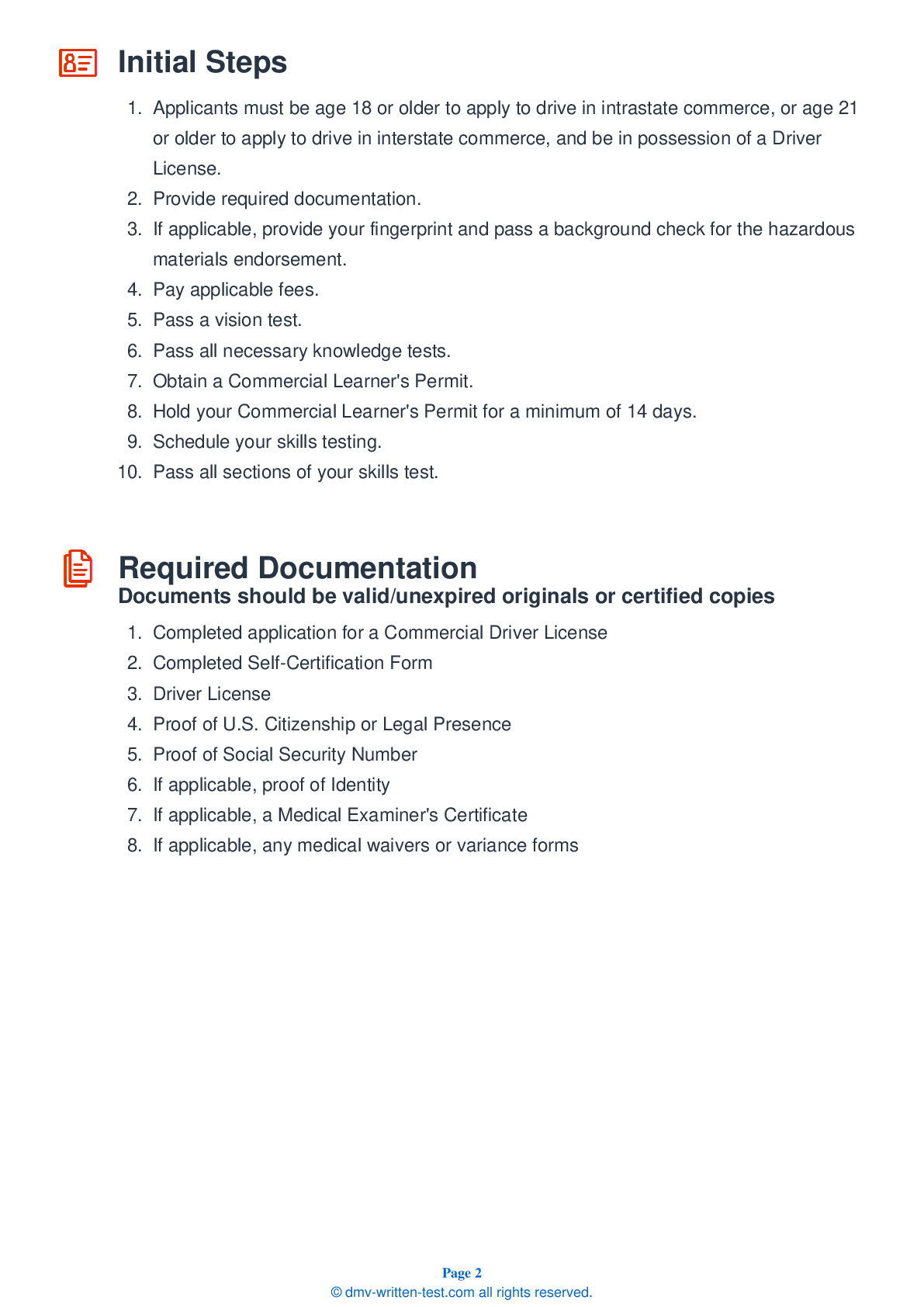
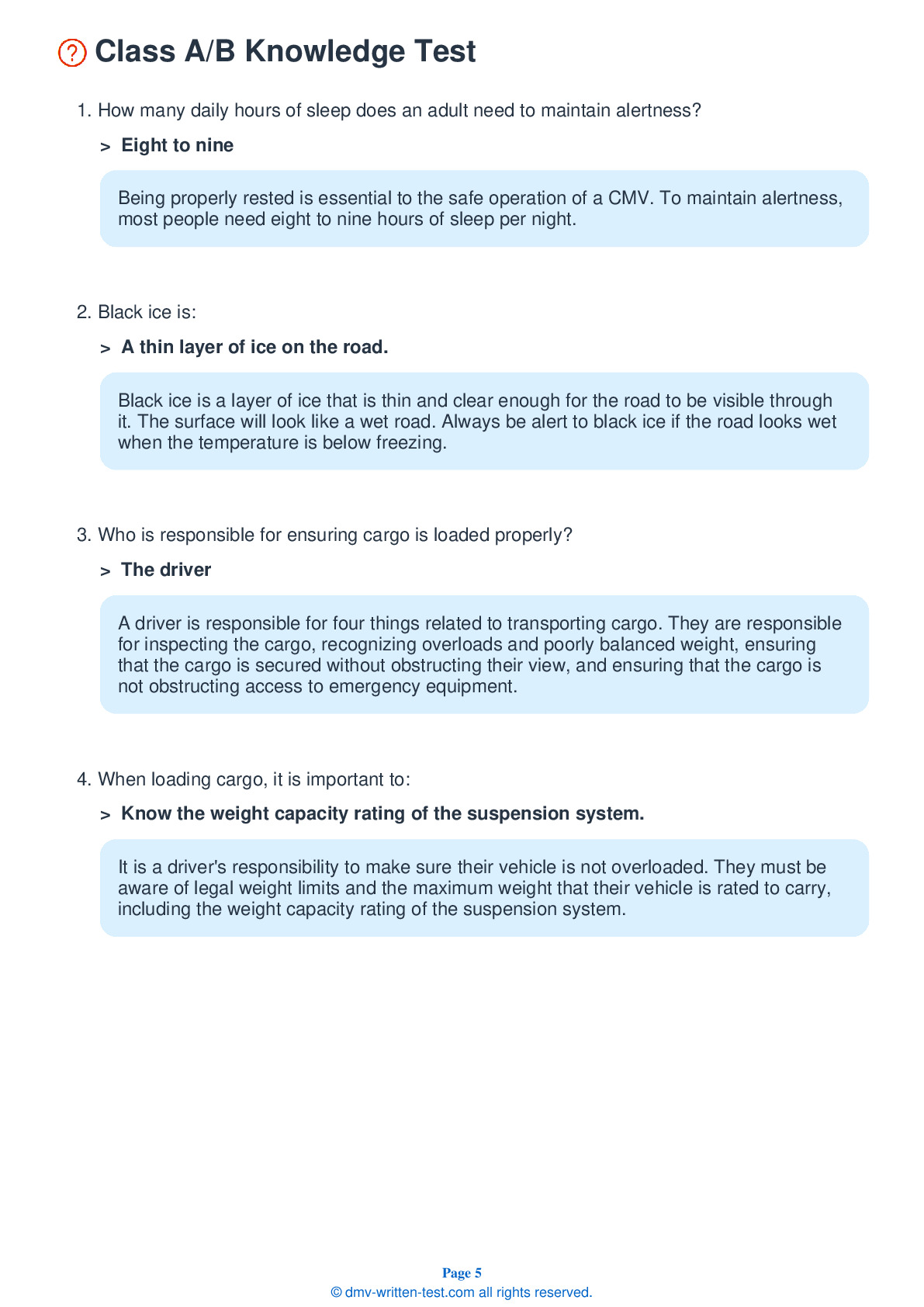
This license is required for driving any legal combination of vehicles, with a gross combination weight rating of 26,001 pounds or more, provided the GVWR of a trailer exceeds 10,000 pounds To receive this license, applicants must pass a 50-question test. To pass, applicants must answer 40 questions correctly. Each question has three possible answer choices. Test questions come from the Alaska Commercial Driver License Manual. Questions come from chapters covering: Introduction, Driving Safely, Transporting Cargo Safely, Air Brakes (if applicable), Combination, Doubles and Hazardous Materials. Endorsements that may be used with a Class A CDL are: Hazardous materials, Tank, Passenger, HazMat and Tank, Air Brakes and School bus.
Number of Question
Passing Score
43. To prevent your vehicle from rolling backward when beginning to move, you can:
Explanation
To ensure that your vehicle does not roll backward when beginning to move after a stop, you should partly engage the clutch before removing your right foot from the brake pedal.
44. A DUI conviction will result in loss of license for a minimum of:
Explanation
A first-time DUI conviction will result in the disqualification of your CDL for at least one year. A second offense will result in a lifetime disqualification.
45. When starting an engine, warning lights and buzzers should:
Explanation
After starting a vehicle's engine, the warning lights and buzzers for oil, coolant, charging circuits, and the Anti-Lock Braking System (ABS) should go out right away.
46. After an accident, flares should be used with caution because:
Explanation
A common cause of vehicle fires in the aftermath of an accident is the improper use of flares near spilled fuel. Use flares with caution.
47. Pre-trip inspections:
Explanation
A vehicle inspection should be completed in the same order every time. This will make it easier for you to learn all of the steps and will make it less likely that you will forget to check something.
48. When applying for a hazardous materials endorsement, being found guilty of which of the following is a disqualifying offense?
Explanation
Amongst other crimes, a felony conviction for arson will disqualify a person from obtaining, renewing, or transferring a hazardous materials endorsement.
49. You should test the low pressure warning signal by:
Explanation
It is essential that your low pressure warning light functions properly. After allowing the system to charge, you can test the warning signal by rapidly applying and releasing the brake pedal. This will release air from the braking system and the warning signal should come on when pressure drops to a dangerous level.
50. Cargo inside a trailer:
Explanation
Cargo inside a trailer must be secured appropriately to prevent it from shifting in transit.
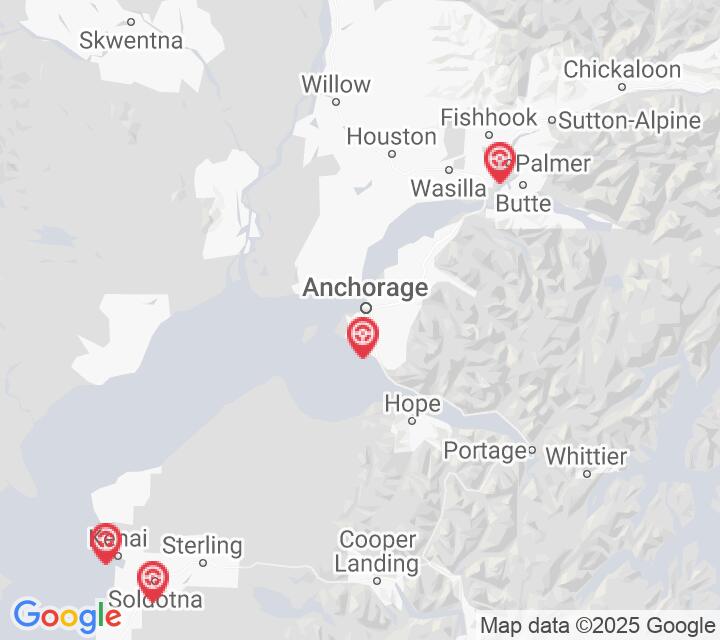
Search the best driving school in your neighbourhood

Frequently Asked Questions
A Class A CDL license in Alaska is a commercial driver's license that allows the driver to operate a combination of vehicles with a total weight of 26,001 pounds or more, provided that the vehicle being towed weighs over 10,000 pounds. This license is required for drivers who want to operate tractor-trailers, tanker trucks, or any other combination of vehicles with a total weight of 26,001 or more pounds.
To obtain a Class A CDL license in Alaska, you must first pass a series of written tests and a skills test that includes a pre-trip inspection, basic control skills, and an on-road driving test. You must also meet certain medical and age requirements. Once you have passed all of the necessary tests and met the requirements, you will be issued a Class A CDL license which will allow you to legally operate commercial vehicles that fall within this category.
To obtain a Class A CDL license in Alaska, you must first pass a series of written tests and a skills test that includes a pre-trip inspection, basic control skills, and an on-road driving test. You must also meet certain medical and age requirements. Once you have passed all of the necessary tests and met the requirements, you will be issued a Class A CDL license which will allow you to legally operate commercial vehicles that fall within this category.
With a Class A CDL license in Alaska, you can operate a combination of vehicles with a gross vehicle weight rating (GVWR) of 26,001 pounds or more, provided that the vehicle being towed weighs over 10,000 pounds. Some examples of vehicles you can operate with a Class A CDL license include:
- Tractor-trailers: These are large trucks that are designed to pull one or more trailers behind them. They are commonly used in the transportation of goods and materials over long distances.
- Tanker trucks: These are trucks that are designed to transport liquids or gases in large tanks. They are commonly used in the transportation of fuel, oil, and chemicals.
- Flatbed trucks: These are trucks that have a flat bed with no sides or roof. They are commonly used in the transportation of large items such as machinery and construction materials.
- Livestock carriers: These are trucks that are designed to transport live animals such as cows, pigs, and horses.
It is important to note that there may be additional endorsements or requirements needed to operate certain types of vehicles, such as hazardous materials (HAZMAT) or passenger vehicles.
- Tractor-trailers: These are large trucks that are designed to pull one or more trailers behind them. They are commonly used in the transportation of goods and materials over long distances.
- Tanker trucks: These are trucks that are designed to transport liquids or gases in large tanks. They are commonly used in the transportation of fuel, oil, and chemicals.
- Flatbed trucks: These are trucks that have a flat bed with no sides or roof. They are commonly used in the transportation of large items such as machinery and construction materials.
- Livestock carriers: These are trucks that are designed to transport live animals such as cows, pigs, and horses.
It is important to note that there may be additional endorsements or requirements needed to operate certain types of vehicles, such as hazardous materials (HAZMAT) or passenger vehicles.
In Alaska, the minimum age requirement for a Class A CDL license is 19 years old. However, to operate a commercial vehicle across state lines or transport hazardous materials (HAZMAT), you must be at least 21 years old.
In addition to the age requirement, you must also meet certain medical and vision standards to obtain a Class A CDL license. You will need to pass a medical examination conducted by a licensed medical examiner and provide proof of your physical fitness. You will also need to pass a vision test and have a visual acuity of at least 20/40 in each eye with or without correction.
You must also have a valid Alaska driver's license and have a clean driving record for at least two years prior to applying for a Class A CDL license. Finally, you must pass a written knowledge test and a skills test that includes a pre-trip inspection, basic control skills, and an on-road driving test.
In addition to the age requirement, you must also meet certain medical and vision standards to obtain a Class A CDL license. You will need to pass a medical examination conducted by a licensed medical examiner and provide proof of your physical fitness. You will also need to pass a vision test and have a visual acuity of at least 20/40 in each eye with or without correction.
You must also have a valid Alaska driver's license and have a clean driving record for at least two years prior to applying for a Class A CDL license. Finally, you must pass a written knowledge test and a skills test that includes a pre-trip inspection, basic control skills, and an on-road driving test.
Yes, you may need additional endorsements for a Class A CDL license depending on the type of vehicle you will be operating and the cargo you will be transporting. The following endorsements are available for Class A CDL holders in Alaska:
1. T - Double/Triple Trailers: This endorsement is required if you will be operating a combination of two or three trailers.
2. P - Passenger: This endorsement is required if you will be operating a vehicle designed to transport 16 or more passengers, including the driver.
3. N - Tank Vehicles: This endorsement is required if you will be operating a vehicle that is designed to transport liquids or gases in bulk quantities.
4. H - Hazardous Materials: This endorsement is required if you will be transporting hazardous materials in quantities that require placards.
5. X - Combination of Tank Vehicle and Hazardous Materials: This endorsement is required if you will be transporting both hazardous materials and liquids or gases in bulk quantities.
You will need to pass additional written tests for each endorsement that you require. You may also need to complete additional training and provide proof of your qualifications, such as hazardous materials training certificates, to obtain certain endorsements.
1. T - Double/Triple Trailers: This endorsement is required if you will be operating a combination of two or three trailers.
2. P - Passenger: This endorsement is required if you will be operating a vehicle designed to transport 16 or more passengers, including the driver.
3. N - Tank Vehicles: This endorsement is required if you will be operating a vehicle that is designed to transport liquids or gases in bulk quantities.
4. H - Hazardous Materials: This endorsement is required if you will be transporting hazardous materials in quantities that require placards.
5. X - Combination of Tank Vehicle and Hazardous Materials: This endorsement is required if you will be transporting both hazardous materials and liquids or gases in bulk quantities.
You will need to pass additional written tests for each endorsement that you require. You may also need to complete additional training and provide proof of your qualifications, such as hazardous materials training certificates, to obtain certain endorsements.
The Class A CDL skills test in Alaska consists of three parts:
1. Pre-Trip Inspection: You will be required to inspect your vehicle to ensure that it is safe to operate. The examiner will ask you to identify and explain various parts of the vehicle and check for any defects or safety issues.
2. Basic Vehicle Control Skills: You will be asked to perform a series of maneuvers that test your ability to control the vehicle in tight spaces. These may include straight-line backing, alley docking, and offset backing.
3. On-Road Driving Test: You will be required to drive on public roads while the examiner observes your ability to handle the vehicle in traffic. You will be tested on your ability to obey traffic laws, maintain control of the vehicle, and communicate effectively with other drivers.
During the skills test, you will be evaluated on a point system. If you accumulate too many points or make a critical error, you may fail the test. To pass the skills test, you must demonstrate a high level of skill and safety in all three parts of the exam. It is important to practice and prepare thoroughly for the skills test to increase your chances of success.
1. Pre-Trip Inspection: You will be required to inspect your vehicle to ensure that it is safe to operate. The examiner will ask you to identify and explain various parts of the vehicle and check for any defects or safety issues.
2. Basic Vehicle Control Skills: You will be asked to perform a series of maneuvers that test your ability to control the vehicle in tight spaces. These may include straight-line backing, alley docking, and offset backing.
3. On-Road Driving Test: You will be required to drive on public roads while the examiner observes your ability to handle the vehicle in traffic. You will be tested on your ability to obey traffic laws, maintain control of the vehicle, and communicate effectively with other drivers.
During the skills test, you will be evaluated on a point system. If you accumulate too many points or make a critical error, you may fail the test. To pass the skills test, you must demonstrate a high level of skill and safety in all three parts of the exam. It is important to practice and prepare thoroughly for the skills test to increase your chances of success.
Yes, there are some restrictions or limitations for drivers with a Class A CDL license in Alaska. The following are some of the most common restrictions:
1. Intrastate Only: If a driver has a restriction of "intrastate only" on their CDL, it means that they are only allowed to operate commercial vehicles within the state of Alaska. They are not permitted to drive outside the state.
2. Air Brake Restriction: If a driver has an "air brake restriction" on their CDL, they are not allowed to operate vehicles with air brakes. They must complete an air brake knowledge test and a skills test in a vehicle equipped with air brakes to have this restriction removed.
3. Automatic Transmission Restriction: If a driver has an "automatic transmission restriction" on their CDL, they may only operate vehicles with automatic transmissions. They must complete a skills test in a vehicle with a manual transmission to have this restriction removed.
4. Lifting Restriction: If a driver has a "lifting restriction" on their CDL, they may not operate vehicles that require the driver to lift heavy objects or equipment.
It is important for drivers to be aware of any restrictions or limitations on their CDL and operate within the parameters of their license. Violating these restrictions can result in fines or even suspension or revocation of the CDL license.
1. Intrastate Only: If a driver has a restriction of "intrastate only" on their CDL, it means that they are only allowed to operate commercial vehicles within the state of Alaska. They are not permitted to drive outside the state.
2. Air Brake Restriction: If a driver has an "air brake restriction" on their CDL, they are not allowed to operate vehicles with air brakes. They must complete an air brake knowledge test and a skills test in a vehicle equipped with air brakes to have this restriction removed.
3. Automatic Transmission Restriction: If a driver has an "automatic transmission restriction" on their CDL, they may only operate vehicles with automatic transmissions. They must complete a skills test in a vehicle with a manual transmission to have this restriction removed.
4. Lifting Restriction: If a driver has a "lifting restriction" on their CDL, they may not operate vehicles that require the driver to lift heavy objects or equipment.
It is important for drivers to be aware of any restrictions or limitations on their CDL and operate within the parameters of their license. Violating these restrictions can result in fines or even suspension or revocation of the CDL license.
No, in Alaska, the Class A CDL written test is only available in English. You must be able to read and understand English to take the written test and obtain a CDL. This is because road signs, signals, and other traffic-related information in the United States are predominantly written in English. However, you may bring an interpreter with you to help translate the questions and answers during the test if necessary. It is important to note that the interpreter must be approved by the Alaska DMV and must not be a family member or friend. If you need an interpreter, you should contact your local DMV office in advance to make arrangements and ensure that your interpreter meets all requirements.
Yes, if you have a disability that may affect your ability to take the Class A CDL written test, you may request accommodations to ensure that you have an equal opportunity to take the test. The Alaska Division of Motor Vehicles (DMV) provides reasonable accommodations based on the Americans with Disabilities Act (ADA) guidelines.
To request accommodations for the Class A CDL written test, you should contact your local DMV office and inform them of your disability and the type of accommodation you require. The DMV may require documentation of your disability from a qualified medical professional to support your request for accommodations.
Examples of accommodations that may be provided include extra time to complete the test, a separate testing room, a reader or sign language interpreter, or a special computer program to assist with reading or answering questions.
It is important to note that accommodations are not guaranteed and are provided on a case-by-case basis. It is recommended that you contact the DMV well in advance of your scheduled test date to allow sufficient time for the accommodation request process.
To request accommodations for the Class A CDL written test, you should contact your local DMV office and inform them of your disability and the type of accommodation you require. The DMV may require documentation of your disability from a qualified medical professional to support your request for accommodations.
Examples of accommodations that may be provided include extra time to complete the test, a separate testing room, a reader or sign language interpreter, or a special computer program to assist with reading or answering questions.
It is important to note that accommodations are not guaranteed and are provided on a case-by-case basis. It is recommended that you contact the DMV well in advance of your scheduled test date to allow sufficient time for the accommodation request process.
If you fail the Class A CDL written test, you may retake the test, but you must wait at least one day before taking it again.
If you fail the test three times, you will have to wait at least 30 days before taking it again. It is important to note that a fee is required each time you take the test, regardless of whether you pass or fail.
Before retaking the test, it is recommended that you review the materials and study thoroughly to increase your chances of passing. The Alaska DMV provides free online practice tests and study guides on their website to help prepare for the written test.
If you continue to struggle with passing the written test, it may be helpful to seek additional resources such as a CDL training program or tutor to help you better understand the materials and prepare for the exam.
If you fail the test three times, you will have to wait at least 30 days before taking it again. It is important to note that a fee is required each time you take the test, regardless of whether you pass or fail.
Before retaking the test, it is recommended that you review the materials and study thoroughly to increase your chances of passing. The Alaska DMV provides free online practice tests and study guides on their website to help prepare for the written test.
If you continue to struggle with passing the written test, it may be helpful to seek additional resources such as a CDL training program or tutor to help you better understand the materials and prepare for the exam.