Knowledge Test Class A
This license is required for driving any legal combination of vehicles, with a gross combination weight rating of 26,001 pounds or more, provided the GVWR of a trailer exceeds 10,000 pounds To receive this license, applicants must pass a 50-question test. To pass, applicants must answer 40 questions correctly. Each question has three or four possible answer choices. Test questions come from the Alabama Commercial Driver License Manual. Questions come from chapters covering: Introduction, Driving Safely, Transporting Cargo Safely, Air Brakes (if applicable), Combination, Doubles and Hazardous Materials. Endorsements that may be used with a Class A CDL are: Hazardous materials, Tank, Passenger, HazMat and Tank, Air Brakes and School bus.
Number of Question
Passing Score
8. When backing with a trailer, turning toward the driver’s side is encouraged because:
Explanation
When driving in reverse, it is always recommended that a driver backs their vehicle toward its left side. This will allow the driver the best possible view of the rear of their vehicle.
9. If there are no warning gates or lights at a railroad crossing, you should:
Explanation
A passive railroad crossing is a crossing that lacks control devices, like gates or warning lights. Before crossing a passive railroad crossing, you should search the tracks for approaching trains coming from either direction.
10. To check the automatic transmission fluid level in some vehicles, you will have to:
Explanation
In some vehicles, it may be necessary to leave the engine running when checking the automatic transmission fluid level.
11. When changing lanes:
Explanation
Always change lanes slowly and smoothly to maintain control of your vehicle. Doing this will also allow a driver that you did not see time to move out of the way of your vehicle. Use the proper turn signal to communicate with other road users.
12. When checking the exhaust system, it should be:
Explanation
When checking the exhaust system, you should verify that no parts of the system are loose, broken, or missing.
13. When should you watch out for black ice?
Explanation
Black ice is a thin layer of ice that is clear enough for the road surface to be seen through it. Be alert to black ice any time the temperature is below freezing and the road surface looks wet.
14. When conducting a vehicle inspection, you will need to identify all of the following, except:
Explanation
During the vehicle inspection test, you must check the power steering belt, water pump belt, alternator belt, and air compressor belt for snugness, cracks, or frays. If any of these components are not belt-driven, you must tell the examiner which one(s), and verify that they are operating properly, mounted securely, and not damaged or leaking.



Frequently Asked Questions
A Class A CDL (Commercial Driver's License) is a type of license required to operate a combination of vehicles with a gross vehicle weight rating (GVWR) of 26,001 pounds or more. In Alabama, this includes vehicles such as tractor-trailers, tanker trucks, and livestock carriers.
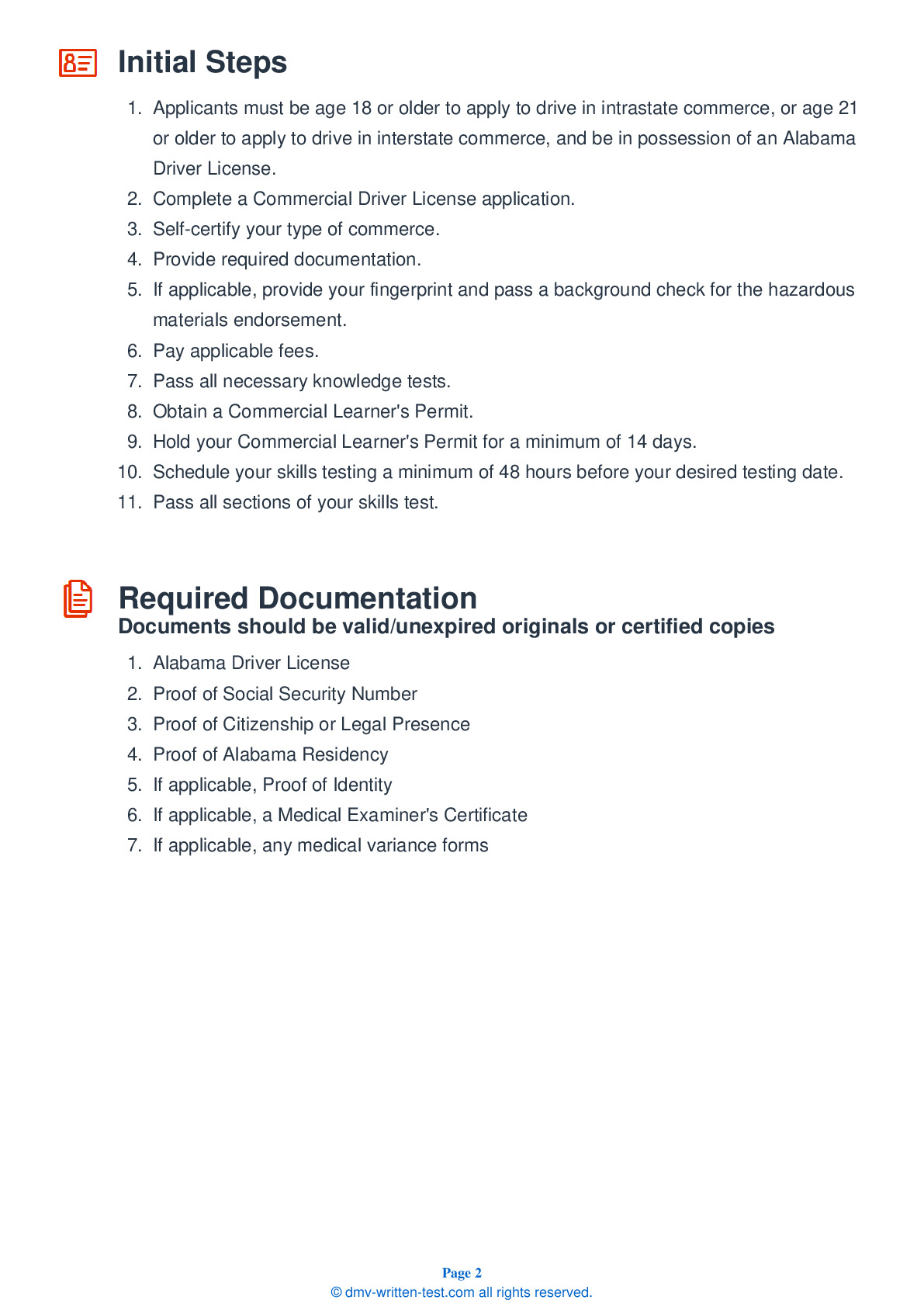
To obtain a Class A CDL license in Alabama, you must follow these steps:
1. Obtain and study the Alabama CDL Handbook: The handbook contains all the information you need to know about the requirements, rules and regulations, and testing procedures for obtaining a Class A CDL license in Alabama.
2. Meet the eligibility requirements: You must be at least 18 years old (21 years old for interstate driving), have a valid Alabama driver's license, and pass a medical examination.
3. Obtain a learner's permit: You need to pass a written test on general knowledge and air brakes to get your learner's permit.
4. Practice driving: You must practice driving with a licensed CDL driver in the passenger seat.
5. Pass the skills test: The skills test consists of three parts - pre-trip inspection, basic vehicle control, and on-road driving.
6. Pay the fees: You will need to pay the fees for obtaining your Class A CDL license in Alabama.
Once you have completed all these steps successfully, you will be issued your Class A CDL license in Alabama.
To obtain a Class A CDL license in Alabama, you must follow these steps:
1. Obtain and study the Alabama CDL Handbook: The handbook contains all the information you need to know about the requirements, rules and regulations, and testing procedures for obtaining a Class A CDL license in Alabama.
2. Meet the eligibility requirements: You must be at least 18 years old (21 years old for interstate driving), have a valid Alabama driver's license, and pass a medical examination.
3. Obtain a learner's permit: You need to pass a written test on general knowledge and air brakes to get your learner's permit.
4. Practice driving: You must practice driving with a licensed CDL driver in the passenger seat.
5. Pass the skills test: The skills test consists of three parts - pre-trip inspection, basic vehicle control, and on-road driving.
6. Pay the fees: You will need to pay the fees for obtaining your Class A CDL license in Alabama.
Once you have completed all these steps successfully, you will be issued your Class A CDL license in Alabama.
With a Class A CDL (Commercial Driver's License) in Alabama, you can operate combination vehicles with a gross vehicle weight rating (GVWR) of 26,001 pounds or more. This includes:
1. Tractor-trailers: These are vehicles consisting of a semi-truck or tractor unit and one or more trailers.
2. Tanker trucks: These are vehicles designed to transport liquid or gaseous materials in tanks.
3. Livestock carriers: These are vehicles designed to transport live animals, such as cows, pigs, and horses.
4. Flatbeds: These are vehicles with an open platform for transporting materials and equipment.
5. Refrigerated trucks: These are vehicles designed to transport temperature-sensitive goods, such as food and pharmaceuticals.
6. Double/Triple trailers: These are combination vehicles consisting of two or three trailers connected to a single tractor unit.
It's important to note that operating any of these types of vehicles requires specialized knowledge and training beyond a regular driver's license.
1. Tractor-trailers: These are vehicles consisting of a semi-truck or tractor unit and one or more trailers.
2. Tanker trucks: These are vehicles designed to transport liquid or gaseous materials in tanks.
3. Livestock carriers: These are vehicles designed to transport live animals, such as cows, pigs, and horses.
4. Flatbeds: These are vehicles with an open platform for transporting materials and equipment.
5. Refrigerated trucks: These are vehicles designed to transport temperature-sensitive goods, such as food and pharmaceuticals.
6. Double/Triple trailers: These are combination vehicles consisting of two or three trailers connected to a single tractor unit.
It's important to note that operating any of these types of vehicles requires specialized knowledge and training beyond a regular driver's license.
To obtain a Class A CDL (Commercial Driver's License) license in Alabama, you must meet the following requirements:
1. Age: You must be at least 18 years old to drive within the state and 21 years old to drive interstate.
2. Alabama driver's license: You must have a valid Alabama driver's license.
3. Medical certification: You must pass a medical examination and obtain a medical certificate indicating that you are physically fit to operate a commercial vehicle.
4. Knowledge test: You must pass a written knowledge test on general knowledge, air brakes, and combination vehicles.
5. Learner's permit: You must obtain a learner's permit by passing the knowledge test.
6. Training: You must complete a training program approved by the Alabama Department of Public Safety (DPS).
7. Skills test: You must pass a skills test that includes pre-trip inspection, basic vehicle control, and on-road driving tests.
8. Fees: You must pay the fees for obtaining your Class A CDL license in Alabama.
It's important to note that obtaining a Class A CDL license requires specialized training beyond what is required for a regular driver's license, and it is important to take the process seriously and prepare thoroughly for each step of the process.
1. Age: You must be at least 18 years old to drive within the state and 21 years old to drive interstate.
2. Alabama driver's license: You must have a valid Alabama driver's license.
3. Medical certification: You must pass a medical examination and obtain a medical certificate indicating that you are physically fit to operate a commercial vehicle.
4. Knowledge test: You must pass a written knowledge test on general knowledge, air brakes, and combination vehicles.
5. Learner's permit: You must obtain a learner's permit by passing the knowledge test.
6. Training: You must complete a training program approved by the Alabama Department of Public Safety (DPS).
7. Skills test: You must pass a skills test that includes pre-trip inspection, basic vehicle control, and on-road driving tests.
8. Fees: You must pay the fees for obtaining your Class A CDL license in Alabama.
It's important to note that obtaining a Class A CDL license requires specialized training beyond what is required for a regular driver's license, and it is important to take the process seriously and prepare thoroughly for each step of the process.
In Alabama, the minimum age requirement for a Class A CDL (Commercial Driver's License) license is 18 years old. However, there are some restrictions for drivers under 21 years old. Drivers who are 18, 19, or 20 years old are not allowed to drive commercial vehicles outside of the state of Alabama, and they cannot transport hazardous materials. Additionally, they cannot operate double or triple trailers. Once a driver reaches the age of 21, these restrictions no longer apply.
Yes, you may need to obtain certain endorsements in addition to your Class A CDL (Commercial Driver's License) license, depending on the type of vehicle you will be operating and the type of cargo you will be transporting. Some common endorsements for a Class A CDL license in Alabama include:
1. Hazmat (H): This endorsement is required if you will be transporting hazardous materials.
2. Tanker (N): This endorsement is required if you will be operating a vehicle that transports liquid or gaseous materials in a tank.
3. Doubles/Triples (T): This endorsement is required if you will be operating a vehicle that has double or triple trailers.
4. Passenger (P): This endorsement is required if you will be transporting passengers, such as a bus or van.
To obtain an endorsement, you must pass a written test specific to that endorsement and pay any associated fees. It's important to note that some endorsements may require additional background checks, such as the Hazmat endorsement which requires a TSA background check.
1. Hazmat (H): This endorsement is required if you will be transporting hazardous materials.
2. Tanker (N): This endorsement is required if you will be operating a vehicle that transports liquid or gaseous materials in a tank.
3. Doubles/Triples (T): This endorsement is required if you will be operating a vehicle that has double or triple trailers.
4. Passenger (P): This endorsement is required if you will be transporting passengers, such as a bus or van.
To obtain an endorsement, you must pass a written test specific to that endorsement and pay any associated fees. It's important to note that some endorsements may require additional background checks, such as the Hazmat endorsement which requires a TSA background check.
The Class A CDL (Commercial Driver's License) skills test in Alabama consists of three parts: a pre-trip inspection, a basic vehicle control test, and an on-road driving test.
1. Pre-Trip Inspection: You will be asked to inspect your vehicle and explain to the examiner what you are checking and why. This includes checking things like the brakes, tires, lights, and other safety features.
2. Basic Vehicle Control Test: You will be asked to demonstrate your ability to control the vehicle in a controlled environment. This includes tasks like backing up, turning around, and parking.
3. On-Road Driving Test: You will be asked to drive on public roads while following the examiner's instructions. The examiner will be looking for your ability to safely operate the vehicle in various driving situations, such as changing lanes, turning, merging onto the highway, and stopping at traffic lights or stop signs.
It's important to note that you must pass each part of the skills test in order to obtain your Class A CDL license in Alabama. Additionally, you must have a valid medical certificate and pass a written knowledge test before you can take the skills test.
1. Pre-Trip Inspection: You will be asked to inspect your vehicle and explain to the examiner what you are checking and why. This includes checking things like the brakes, tires, lights, and other safety features.
2. Basic Vehicle Control Test: You will be asked to demonstrate your ability to control the vehicle in a controlled environment. This includes tasks like backing up, turning around, and parking.
3. On-Road Driving Test: You will be asked to drive on public roads while following the examiner's instructions. The examiner will be looking for your ability to safely operate the vehicle in various driving situations, such as changing lanes, turning, merging onto the highway, and stopping at traffic lights or stop signs.
It's important to note that you must pass each part of the skills test in order to obtain your Class A CDL license in Alabama. Additionally, you must have a valid medical certificate and pass a written knowledge test before you can take the skills test.
Yes, there are several restrictions and limitations for drivers with a Class A CDL (Commercial Driver's License) license in Alabama. Some of the most common restrictions include:
1. Air Brake Restriction: If you take the skills test in a vehicle without air brakes, you will receive an air brake restriction on your license. This means that you are not authorized to operate a commercial vehicle that has air brakes.
2. Automatic Transmission Restriction: If you take the skills test in a vehicle with an automatic transmission, you will receive an automatic transmission restriction on your license. This means that you are not authorized to operate a commercial vehicle with a manual transmission.
3. Intrastate-Only Restriction: If you only plan to drive within the state of Alabama, you may receive an intrastate-only restriction on your license. This means that you are not authorized to operate a commercial vehicle outside of the state of Alabama.
4. Hazmat Endorsement Restriction: If you have a Hazmat endorsement on your license, there may be additional restrictions related to transporting hazardous materials. For example, you may be required to follow certain routes or have additional safety equipment on your vehicle.
It's important to note that these restrictions and limitations can vary depending on your specific situation and endorsements. It's always best to check with your local DMV or licensing agency for the most up-to-date information.
1. Air Brake Restriction: If you take the skills test in a vehicle without air brakes, you will receive an air brake restriction on your license. This means that you are not authorized to operate a commercial vehicle that has air brakes.
2. Automatic Transmission Restriction: If you take the skills test in a vehicle with an automatic transmission, you will receive an automatic transmission restriction on your license. This means that you are not authorized to operate a commercial vehicle with a manual transmission.
3. Intrastate-Only Restriction: If you only plan to drive within the state of Alabama, you may receive an intrastate-only restriction on your license. This means that you are not authorized to operate a commercial vehicle outside of the state of Alabama.
4. Hazmat Endorsement Restriction: If you have a Hazmat endorsement on your license, there may be additional restrictions related to transporting hazardous materials. For example, you may be required to follow certain routes or have additional safety equipment on your vehicle.
It's important to note that these restrictions and limitations can vary depending on your specific situation and endorsements. It's always best to check with your local DMV or licensing agency for the most up-to-date information.
No, in Alabama, the Class A CDL (Commercial Driver's License) written test is only available in English. The Alabama Department of Public Safety (DPS) requires that all applicants must be able to read and understand English to pass the written test and receive a CDL license. This is because the road signs, traffic laws, and other driving-related information in the United States are primarily presented in English.
However, if you need assistance with reading or understanding English, you may be able to bring a translator with you to the DMV to assist you during the written test. But keep in mind that the translator must be approved by the DMV or DPS. You should contact your local DMV or DPS office for more information on their specific language assistance policies.
However, if you need assistance with reading or understanding English, you may be able to bring a translator with you to the DMV to assist you during the written test. But keep in mind that the translator must be approved by the DMV or DPS. You should contact your local DMV or DPS office for more information on their specific language assistance policies.
Yes, the Alabama Department of Public Safety (DPS) provides accommodations for individuals with disabilities who need assistance with the Class A CDL (Commercial Driver's License) written test. If you have a disability that may affect your ability to take the written test, you should contact your local DMV or DPS office to request accommodations.
Some examples of accommodations that may be available include:
1. Extended testing time
2. A separate testing area
3. Large print or Braille test materials
4. Assistance from a reader or scribe
However, keep in mind that you must provide documentation of your disability and your need for accommodations. The DMV or DPS may require a letter from your doctor or other medical professional to verify your disability and the necessary accommodations.
It's important to request accommodations as early as possible to ensure that they can be provided in a timely manner.
Some examples of accommodations that may be available include:
1. Extended testing time
2. A separate testing area
3. Large print or Braille test materials
4. Assistance from a reader or scribe
However, keep in mind that you must provide documentation of your disability and your need for accommodations. The DMV or DPS may require a letter from your doctor or other medical professional to verify your disability and the necessary accommodations.
It's important to request accommodations as early as possible to ensure that they can be provided in a timely manner.
Yes, if you fail the Class A CDL (Commercial Driver's License) written test in Alabama, you can retake it after a certain period. The waiting period depends on how many times you have failed the test.
If you fail the test for the first time, you can retake it the next business day. If you fail it a second time, you must wait at least seven days before retaking it. If you fail it a third or subsequent time, you must wait at least 14 days before retaking it.
Keep in mind that each time you retake the written test, you will need to pay the testing fee again. Therefore, it's important to study and prepare properly before taking the exam to increase your chances of passing on the first try.
In addition, if you fail the test three times, you may be required to complete additional training or education before being allowed to retake the test again. This is to ensure that you have a better understanding of the material and are better prepared for the exam.
If you fail the test for the first time, you can retake it the next business day. If you fail it a second time, you must wait at least seven days before retaking it. If you fail it a third or subsequent time, you must wait at least 14 days before retaking it.
Keep in mind that each time you retake the written test, you will need to pay the testing fee again. Therefore, it's important to study and prepare properly before taking the exam to increase your chances of passing on the first try.
In addition, if you fail the test three times, you may be required to complete additional training or education before being allowed to retake the test again. This is to ensure that you have a better understanding of the material and are better prepared for the exam.
